Welcome to the forefront of conversational AI as we explore the fascinating world of AI chatbots in our dedicated blog series. Discover the latest advancements, applications, and strategies that propel the evolution of chatbot technology. From enhancing customer interactions to streamlining business processes, these articles delve into the innovative ways artificial intelligence is shaping the landscape of automated conversational agents. Whether you’re a business owner, developer, or simply intrigued by the future of interactive technology, join us on this journey to unravel the transformative power and endless possibilities of AI chatbots.
Industry
About
Media
Contact
Conversational AI in Healthcare Market is set to grow from USD 21.62 Billion in 2025 to USD 212.92 Billion by 2036, with a CAGR of 25.7%. Chatbots is poised to dominate the component segment with a 35.7% share, while Speech Recognition & Generation is expected to lead the technology category at 30.8%.
Published on April 01, 2026
Reviewed By Sabyasachi Ghosh
Study Period (2026 – 2036)
The conversational AI in healthcare market was valued at USD 17.2 billion in 2025, projected to reach USD 21.62 billion in 2026, and is forecast to expand to USD 212.92 billion by 2036 at a 25.7% CAGR. Clinical workforce shortages and escalating patient engagement demands are driving healthcare systems to deploy conversational AI platforms across triage, appointment management, and chronic disease monitoring workflows. The integration of large language models with electronic health record systems is creating a structural shift in how patients interact with healthcare providers.
FMI is of the opinion that conversational AI adoption in healthcare has moved past pilot-stage experimentation into operational deployment at scale. Health systems executing patient access improvement programs now require AI-powered chatbots and virtual assistants that can handle appointment scheduling, symptom pre-screening, and medication adherence follow-up without human agent intervention. Natural language processing accuracy improvements and compliance with HIPAA and GDPR data handling requirements have lowered the deployment risk threshold, enabling procurement teams to approve enterprise-wide rollouts.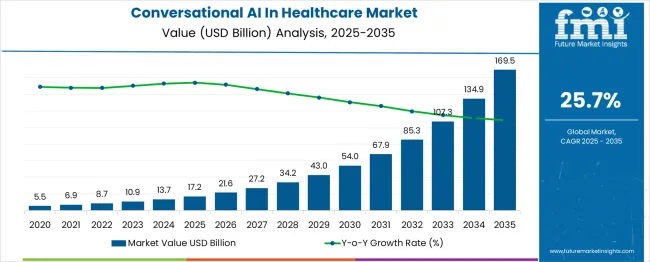
Source: Future Market Insights, 2026
Regional growth trajectories reflect healthcare digitization maturity and investment intensity. China leads at 34.7% CAGR, driven by national health informatization mandates and large patient populations requiring scalable triage solutions. India follows at 32.1% as telemedicine adoption accelerates across tier-2 and tier-3 cities. Germany advances at 29.6%, supported by the Digital Healthcare Act and electronic prescription integration requirements. France expands at 27%, the United Kingdom maintains 24.4% growth driven by NHS digital transformation programs, and the United States registers 21.9% expansion anchored by Medicare reimbursement pathway expansions for remote patient monitoring.
Conversational AI in healthcare encompasses artificial intelligence platforms that use natural language processing, speech recognition, machine learning, and large language models to enable automated, human-like interactions between patients, clinicians, and healthcare systems. These solutions include chatbots, virtual health assistants, speech recognition clinical documentation systems, and dialogue management platforms deployed across hospitals, clinics, pharmaceutical companies, and health insurance organizations.
Market scope includes chatbot platforms, virtual health assistants, speech recognition and generation systems, natural language processing engines, machine learning and deep learning clinical models, large language model integrations, and dialogue management orchestration tools for healthcare applications. Patient engagement, clinical decision support, remote monitoring, telemedicine, administrative automation, and pharmaceutical assistance use cases are covered.
General-purpose consumer virtual assistants without healthcare-specific clinical training are excluded. Basic interactive voice response (IVR) telephone systems lacking natural language understanding, standalone electronic health record software without conversational interface layers, and medical device hardware fall outside analytical parameters.
Market expansion is being supported by the increasing demand for automated patient engagement solutions and the corresponding need for intelligent healthcare communication systems. Modern healthcare providers are increasingly focused on leveraging AI technologies that can enhance patient experience, reduce administrative burden, and improve clinical outcomes through personalized care delivery. Conversational AI's proven effectiveness in handling routine inquiries, providing medical information, and supporting clinical decision-making makes it an essential component in digital health transformation strategies.
The growing focuses on patient-centered care and personalized medicine is driving demand for AI solutions that can understand natural language, process medical data, and provide contextually relevant responses. Healthcare organizations' preference for scalable solutions that combine multiple AI capabilities including speech recognition, natural language processing, and machine learning is creating opportunities for comprehensive conversational AI platforms. The rising influence of value-based care models and regulatory support for AI adoption in healthcare is also contributing to increased technology implementation across different healthcare settings and specialties.
The market is segmented by component, technology outlook, application outlook, end use, and region. By component, the market is divided into chatbots, virtual assistants, speech recognition systems, and services. Based on technology outlook, the market is categorized into speech recognition & generation, natural language processing (NLP) & understanding (NLU), machine learning & deep learning models, large language models (LLMs) & generative AI, and dialogue management & orchestration.
In terms of application outlook, the market is segmented into patient engagement & support, mental health support & therapy bots, medical diagnosis & clinical decision support, remote patient monitoring, telemedicine & virtual consultations, administrative & workflow automation, pharmaceutical & drug information assistance, and medical training & education. By end use, the market is classified into hospitals & clinics, patients & individuals, healthcare payers & insurance companies, pharmaceutical & life sciences companies, and others. Regionally, the market is divided into North America, Europe, East Asia, South Asia & Pacific, Latin America, and Middle East & Africa.
The chatbots component is projected to account for 35.7% of the conversational AI in healthcare market in 2026, establishing its position as the most widely adopted conversational AI solution in healthcare settings. Healthcare organizations increasingly recognize chatbots' effectiveness in handling routine patient inquiries, appointment scheduling, medication reminders, and basic health information provision. These AI-powered systems provide 24/7 availability, reduce staff workload, and improve patient satisfaction through immediate response capabilities.
This component forms the foundation of most healthcare communication strategies, as it represents the most accessible and cost-effective entry point for implementing conversational AI technology. Clinical validation and successful deployment cases continue to strengthen healthcare providers' confidence in chatbot solutions. With increasing patient expectations for digital health services and growing need for scalable patient support systems, chatbots align with both operational efficiency and patient experience goals. Their broad applicability across different healthcare specialties and patient demographics ensures market dominance, making them the primary driver of conversational AI adoption in healthcare organizations.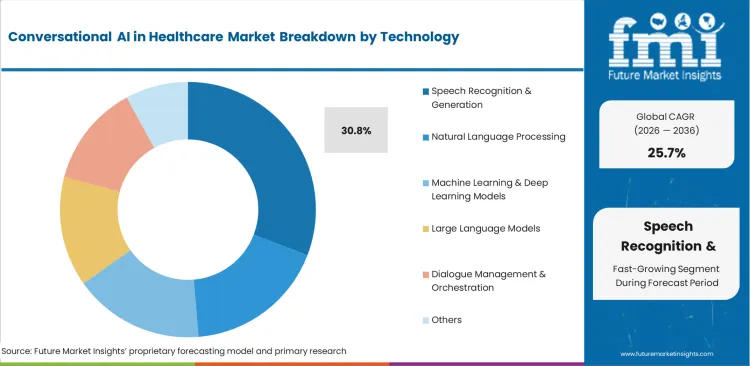
Speech recognition & generation technology is projected to represent 30.8% of conversational AI in healthcare demand in 2026, highlighting its critical role in enabling natural, hands-free interactions between healthcare providers and AI systems. Healthcare professionals value speech-enabled solutions for their ability to integrate seamlessly into clinical workflows, allowing for efficient documentation, voice-activated system navigation, and real-time information retrieval during patient consultations.
The segment benefits from continuous improvements in accuracy, multilingual support, and medical terminology recognition capabilities. Healthcare organizations are increasingly adopting speech-enabled AI solutions to reduce documentation burden on clinicians, improve data capture efficiency, and enhance overall productivity. The technology's ability to process complex medical terminology and maintain high accuracy in noisy clinical environments makes it particularly valuable for hospitals and medical practices seeking to optimize their operational efficiency while maintaining quality patient care standards.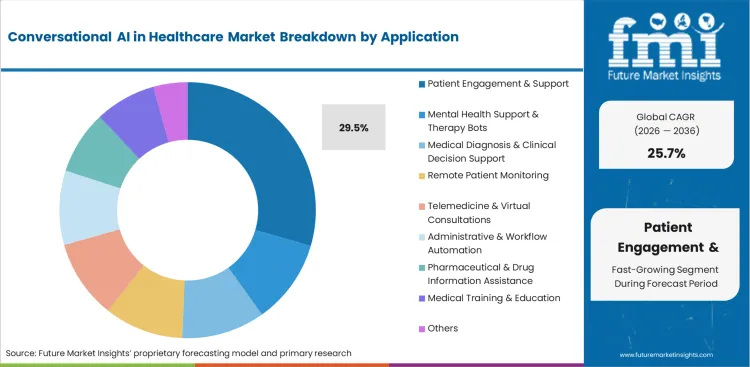
The patient engagement & support application is forecasted to contribute 29.5% of the conversational AI in healthcare market in 2026, reflecting the growing importance of patient-centered care delivery and continuous health management. Healthcare providers recognize that effective patient engagement directly impacts treatment adherence, health outcomes, and overall care quality. Conversational AI solutions enable personalized patient interactions, proactive health monitoring, and timely intervention capabilities that support better health management.
This application segment addresses critical healthcare challenges including patient education, medication compliance, appointment scheduling, and post-discharge follow-up care. The growing focus on preventive care and chronic disease management creates significant opportunities for AI-powered patient engagement solutions. Healthcare organizations are investing in conversational AI platforms that can deliver personalized health recommendations, monitor patient symptoms, and provide immediate support for health-related questions, positioning patient engagement as a fundamental component of modern healthcare delivery strategies.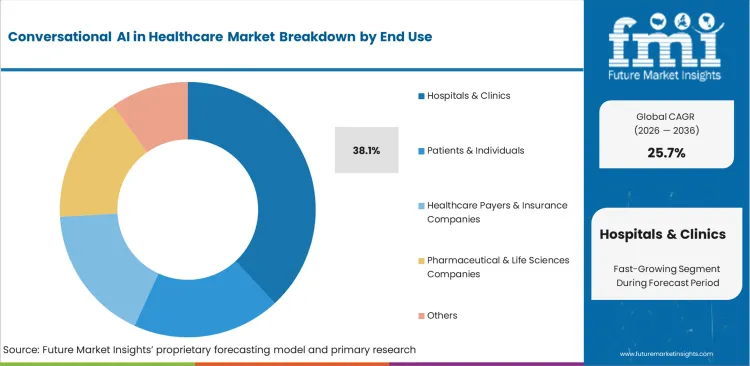
The hospitals & clinics end-use segment is projected to represent 38.1% of conversational AI in healthcare market demand in 2026, underscoring their role as primary adopters of AI-powered communication and automation technologies. These healthcare facilities face significant operational challenges including high patient volumes, complex administrative processes, and the need for efficient clinical workflows. Conversational AI solutions provide scalable solutions for patient triage, appointment management, clinical documentation, and staff support services.
Large healthcare institutions have the resources and technical infrastructure necessary to implement comprehensive conversational AI platforms, making them ideal early adopters of advanced AI technologies. The segment benefits from growing recognition of AI's potential to improve operational efficiency, reduce costs, and enhance patient care quality. As hospitals and clinics continue to face staffing challenges and increasing patient expectations, conversational AI represents a strategic technology investment that addresses multiple operational pain points while supporting improved patient outcomes and satisfaction levels.
The conversational AI in healthcare market is advancing rapidly due to increasing healthcare digitization, growing demand for automated patient engagement solutions, and rising adoption of AI-powered clinical decision support systems. The market faces challenges including data privacy concerns, integration complexity with existing healthcare systems, and regulatory compliance requirements. Innovation in natural language processing capabilities and healthcare-specific AI model development continue to influence product advancement and market expansion patterns.
The growing adoption of telemedicine platforms is creating significant opportunities for conversational AI integration to enhance virtual care delivery and patient interaction capabilities. Remote patient monitoring solutions require intelligent communication systems that can process patient data, provide automated feedback, and alert healthcare providers about critical health changes. Conversational AI technologies enable seamless integration between monitoring devices, patient communication channels, and clinical management systems, supporting comprehensive remote care delivery.
Healthcare organizations are increasingly implementing advanced AI technologies including large language models and generative AI to enhance conversational capabilities and clinical decision support. These technologies enable more sophisticated natural language understanding, medical knowledge processing, and personalized patient interaction capabilities. Advanced AI models can process complex medical literature, provide evidence-based recommendations, and support healthcare professionals in making informed clinical decisions through intelligent dialogue systems..webp "Top Country Growth Comparison Conversational Ai In Healthcare Market Cagr (2026 2036)")
Source: FMI analysis based on primary research and proprietary forecasting model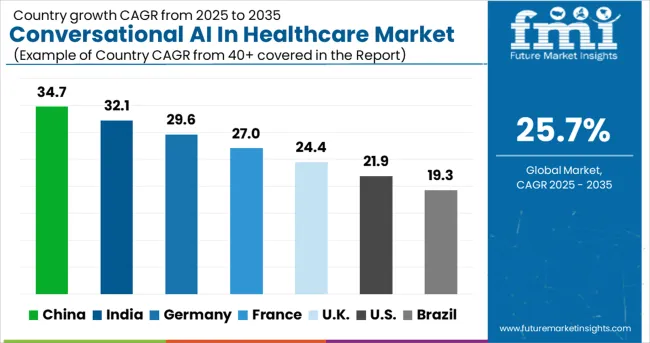
The global conversational AI in healthcare market is anticipated to grow at a CAGR of 25.7% from 2026 to 2036. China leads with a CAGR of 34.7%, supported by large-scale investments in AI-driven healthcare infrastructure and rapid adoption of virtual assistants. India follows at 32.1%, driven by expanding telemedicine services and the growing need for AI-based patient engagement solutions. Germany records 29.6% growth, reflecting advancements in precision healthcare and integration of AI in diagnostics. France is projected at 27.0%, supported by digital transformation in patient management. The UK grows at 24.4% with strong use of AI triage systems, while the USA expands at 21.9% through adoption of virtual health assistants and AI-enabled chronic care management.
The report covers an in-depth analysis of 40+ countries, top-performing countries are highlighted below.
China is projected to record the highest CAGR of 34.7% between 2026 and 2036, supported by government backed digital health reforms and rapid integration of AI technology across hospitals. Conversational AI is being implemented to address physician shortages and expand healthcare access in rural regions. Chinese technology leaders have developed AI assistants optimized for Mandarin and regional dialects, enhancing inclusivity in healthcare delivery. Smart hospital programs backed by national policy have prioritized AI enabled patient interaction systems, while cross border collaborations with international firms have expanded clinical capabilities. With heavy investment in healthcare digitization and data infrastructure, conversational AI is expected to play a central role in strengthening telemedicine and hospital management platforms in China throughout the forecast period.
India will witness a CAGR of 32.1% from 2026 to 2036 in conversational AI healthcare, supported by rapid digital adoption and expansion of telemedicine platforms. Hospitals and startups have adopted AI powered assistants to manage scheduling, symptom checks, and follow up care. Government initiatives under the digital health mission have created opportunities for AI vendors to scale across urban and rural facilities. IT service firms have expanded investments in healthcare AI, integrating chatbots into electronic health records and insurance systems. A fast growing startup ecosystem has developed multilingual conversational AI tools, ensuring patient accessibility across India’s diverse languages. With strong policy push and private sector innovation, conversational AI is being positioned as a central pillar for strengthening healthcare efficiency in India.
Germany is forecasted to grow at a CAGR of 29.6% between 2026 and 2036, supported by regulatory clarity and high healthcare spending. Hospitals have accelerated the use of AI powered assistants for outpatient management, enabling reduced administrative burden and quicker communication. Pharmaceutical companies have utilized conversational AI to improve patient education and adherence to therapies. Compliance with GDPR has shaped product deployment strategies, pushing vendors to design highly secure systems. Collaborations between domestic health technology companies and global AI leaders have accelerated innovation, particularly in clinical decision support. As electronic health record integration progresses, conversational AI is expected to play a central role in improving efficiency across German healthcare infrastructure.
France is projected to expand at a CAGR of 27.0% from 2026 to 2036, with hospitals adopting conversational AI to manage patient intake, support chronic disease monitoring, and provide multilingual care. Health insurers have introduced AI bots to streamline claim handling and improve response times. The government’s focus on AI sovereignty has encouraged local startups to develop healthcare specific natural language solutions. International players have entered through collaborations with public and private providers, accelerating adoption across hospitals. Limited pilots have already demonstrated improved patient communication, and funding allocations under the national AI strategy are expected to strengthen deployment further. With an focus on both local innovation and global partnerships, France is building a robust ecosystem for conversational AI in healthcare.
The United Kingdom will grow at a CAGR of 24.4% between 2026 and 2036, supported by NHS digital initiatives and private sector adoption. Conversational AI has been deployed to reduce patient wait times through triage systems, appointment scheduling, and mental health support. NHS trusts have prioritized AI assistants for reminders and consultations, while private providers have used chatbots to strengthen customer experience. Vendors have partnered with IT integrators to ensure system compatibility across care networks. Regulatory frameworks have been enforced to protect patient data, requiring compliance with GDPR standards. The market outlook remains positive as conversational AI becomes central to integrated care pathways and population health management across the UK.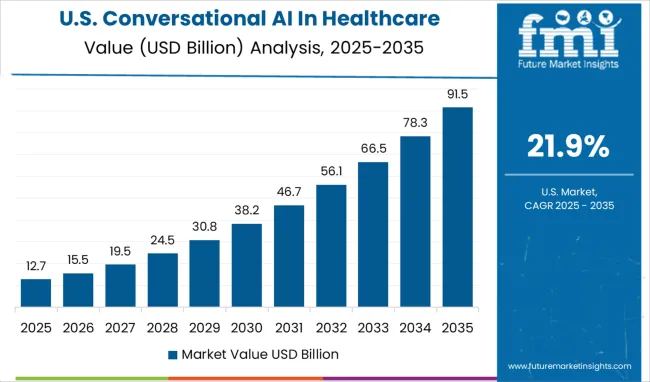
Conversational AI in healthcare within the United States is set to expand at a CAGR of 21.9% from 2026 to 2036, driven by large scale digital health investments and patient engagement initiatives. Hospitals have increasingly adopted AI powered assistants for managing electronic health records and reducing clinician workload, while insurers have prioritized AI chatbots for claim support and customer communication. Vendors have shaped competition through partnerships between technology giants and hospital networks, enabling ambient intelligence and real time clinical documentation. Strict regulatory oversight has defined product development, ensuring compliance with HIPAA and other standards. Adoption of conversational AI is being accelerated as patient centric models become a priority, enabling reduced wait times, virtual triage, and improved chronic disease management across overstretched health facilities in the country.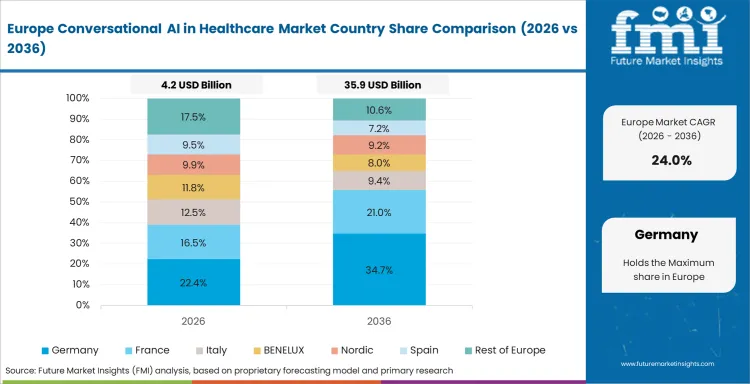
The market in Europe demonstrates strong development across major healthcare systems with Germany showing significant presence through its advanced healthcare infrastructure and focuses on digital health innovation, supported by healthcare institutions leveraging AI technologies to improve patient care efficiency and clinical workflow optimization. France represents a substantial market driven by its comprehensive healthcare system and government initiatives promoting digital health transformation, with organizations implementing conversational AI solutions for patient engagement and administrative automation.
The UK exhibits considerable growth through its National Health Service digital initiatives and focus on AI-powered healthcare solutions, with healthcare providers implementing conversational AI systems for patient triage, appointment scheduling, and clinical decision support. Italy and Spain show expanding adoption of AI technologies in healthcare settings, particularly in patient communication and telemedicine applications. BENELUX countries contribute through their advanced healthcare technology infrastructure and focuses on patient-centered digital health solutions, while Eastern Europe and Nordic regions display growing potential driven by increasing healthcare digitization and expanding access to AI-powered patient engagement platforms.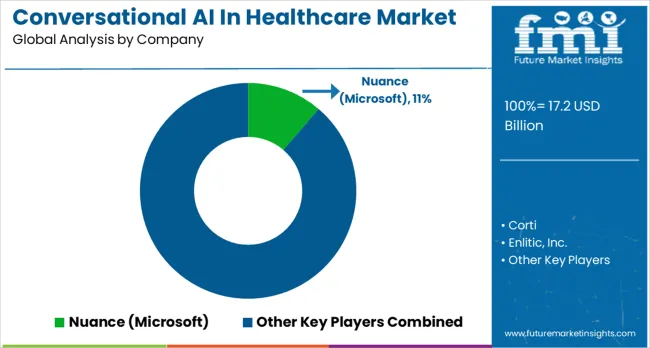
The conversational AI in healthcare market has been shaped by technology giants, AI-driven startups, and healthcare-focused innovators, competing on accuracy, integration, and patient engagement. Nuance (Microsoft), IBM, Google, and NVIDIA have concentrated on large-scale AI infrastructure, natural language processing, and deep learning models that enhance clinical documentation, patient communication, and diagnostic support. Their strategies focuses scalability, data security, and compliance with healthcare regulations. Corti, Enlitic, and Oncora Medical have targeted specialized applications, including real-time emergency support, radiology interpretation, and oncology workflows, positioning themselves as niche leaders.
UST, Authenticx, Hyro, and Notable have differentiated through workflow automation and virtual assistants designed to reduce provider burden and streamline patient interactions. Mediktor and Babylon Health have advanced symptom-checking platforms and patient triage systems, focusing on accessible healthcare delivery. Rasa Technologies, Fireflies, and Abridge AI, Inc. have built strong positions with conversational frameworks, transcription tools, and medical note automation. Product brochures highlight features such as multilingual capability, HIPAA compliance, integration with electronic health records, and AI models trained on diverse clinical datasets.
Competition revolves around trust, adaptability, and clinical validation. Nuance and IBM emphasize proven deployments across hospitals and health systems, while NVIDIA and Google position their platforms as foundational AI engines powering multiple healthcare applications. Startups highlight agility, domain-specific AI, and affordability. Brochures consistently present value through reduced administrative workload, improved diagnostic accuracy, and enhanced patient experiences. The market has evolved into a landscape where transparency, accuracy, and seamless integration into healthcare ecosystems define customer preference, with product literature serving as a primary tool to project technical credibility and practical impact.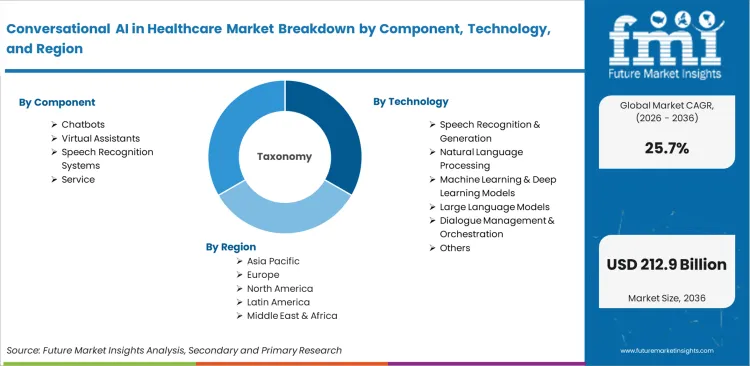
This bibliography is provided for reader reference. The full Future Market Insights report contains the complete reference list with primary research documentation.
How large is the demand for Conversational AI in Healthcare in the global market in 2026?
Demand for Conversational AI in Healthcare in the global market is estimated to be valued at USD Billion 21.62 billion in 2026.
What will be the market size of Conversational AI in Healthcare in the global market by 2036?
Market size for Conversational AI in Healthcare is projected to reach USD Billion 212.92 billion by 2036.
What is the expected demand growth for Conversational AI in Healthcare in the global market between 2026 and 2036?
Demand for Conversational AI in Healthcare is expected to grow at a CAGR of 25.7% between 2026 and 2036.
Which Component is poised to lead global sales by 2026?
Chatbots accounts for 35.7% share in 2026 based on established adoption and operational deployment across major end-use categories.
What is driving demand in China?
China leads with a 34.7% CAGR through 2036, driven by large-scale infrastructure investment, policy mandates, and growing domestic demand.
What is the India growth outlook in this report?
India is projected to grow at a CAGR of 32.1% during 2026 to 2036.
What is Conversational AI in Healthcare and what is it mainly used for?
Conversational AI in healthcare encompasses artificial intelligence platforms that use natural language processing, speech recognition, machine learning, and large language models to enable automated, human-like interactions between patients, clinicians, and healthcare systems. These solutions include chatbots, virtual health assistants, speech recognition clinical documentation systems, and dialogue management platforms deployed across hospitals, clinics, pharmaceutical companies, and health insurance organizations.
How does FMI build and validate the Conversational AI in Healthcare forecast?
Forecasting models apply a bottom-up methodology starting with global installed base metrics and cross-validate projections against publicly reported expenditure volumes and primary research findings.
Key Statistics
About The Report
Select license type
DELIVERED AS: PDF, EXCEL, ONLINE
250 pages
Healthcare
Healthcare IT
Clients
Member of
Greater New York Chamber of Commerce
Recognized by
Awarded by
SILVER STEVIE® WINNER
Asia Pacific Stevie Awards – 2023
BRONZE STEVIE® Award
20th annual IBAs
Quick Contact
Get Free Sample PDF 
Your personal details are safe with us. Privacy Policy*
Full Research Suite comprises of:
Market outlook & trends analysis
Interviews & case studies
Strategic recommendations
Vendor profiles & capabilities analysis
5-year forecasts
8 regions and 60+ country-level data splits
Market segment data splits
12 months of continuous data updates
DELIVERED AS:
PDF EXCEL ONLINE
Full Research Suite
$5000
$7500
$10000
Healthcare Air Purifier Market
Healthcare AI Computer Vision Market
Conversational AI Market
Healthcare Cold Chain Logistics Market
Healthcare Regulatory Affairs Outsourcing Market
Stain Remover and Booster Chemicals for Healthcare Laundry Market
Air Cannon System Market
AI Fetal Ultrasound View Detection Software Market
AI Portable Chest X-ray Triage Device Market
AI Colonoscopy Withdrawal Quality Monitoring System Market
AI Capsule Endoscopy Reading Platform Market
AI-Powered Formulary Management Market
Airport Cargo Community Digital Collaboration Platforms Market
AI-Based Medical Imaging Algorithm Validation Test Platforms Market
Air Cargo Capacity and Allotment Marketplace Platforms Market
AI-Assisted NDT Data Analytics and Defect Characterization Platforms Market
Air Taxi Exterior Component Systems Market
Healthcare Data De-Identification Assurance Market
AI-Enabled Semiconductor Defect Classification and Review Systems Market
AI Radiology Worklist Orchestration Market
Future Market Insights is registered in the state of Delaware as Future Market Insights, Inc. Christiana Corporate, 200 Continental Drive, Suite 401, Newark, Delaware – 19713, United States
Email: sales@futuremarketinsights.com
T: +1-347-918-3531
Future Market Insights, Inc.
616 Corporate Way, Suite 2-9018, Valley Cottage,
NY 10989, United States
Email: sales@futuremarketinsights.com
Future Market Insights, Inc.
1602-6 Jumeirah Bay X2 Tower, Plot No: JLT-PH2-X2A, Jumeirah Lakes Towers, Dubai, United Arab Emirates
Email: sales@futuremarketinsights.com
Future Market Insights, Inc.
3rd Floor, 207 Regent Street,
W1B 3HH, London, United Kingdom
T: + 44 (0) 20 8123 9659
Future Market Insights Global & Consulting Pvt. Ltd.,
IndiaLand Global Tech Park, Zone 1, Unit UG-1, Behind Grand HighStreet, Phase 1, Hinjawadi, MH, Pune – 411057, India
Email: sales@futuremarketinsights.com
Reports
Methodology
About
Help
Copyright © Future Market Insights, Inc.
Conversational AI in Healthcare Market
– Get Free Brochure –
Your personal details are safe with us. Privacy Policy*
Thank you!
You will receive an email from our Business Development Manager. Please be sure to check your SPAM/JUNK folder too.
