Welcome to the forefront of conversational AI as we explore the fascinating world of AI chatbots in our dedicated blog series. Discover the latest advancements, applications, and strategies that propel the evolution of chatbot technology. From enhancing customer interactions to streamlining business processes, these articles delve into the innovative ways artificial intelligence is shaping the landscape of automated conversational agents. Whether you’re a business owner, developer, or simply intrigued by the future of interactive technology, join us on this journey to unravel the transformative power and endless possibilities of AI chatbots.
Capabilities
Methods
Capabilities
Technologies
Capabilities
Tools
Capabilities
Technologies
Capabilities
Technologies
Capabilities
Engagement Models
Capabilities
Frameworks
Capabilities
Technologies
Capabilities
Technologies
Capabilities
Technologies
Capabilities
Technologies
Capabilities
Search Solutions
For Commerce
Silk Design System
AI Product Discovery
For other industries
Case studies
Scaling Core Apps For Delivery Hero, Local Delivery & Q-Commerce Giant
How Vinted Expanded its Global Marketplace with On-Demand Team Extension
Other projects
Learn more
Join Netguru
Blog
Overcoming Integration Challenges in Super App Development
Building Data Foundations: The Key to Scalable Enterprise AI
Newsletters and originals
Services
Year
Netguru built Chatguru, a production ready white label AI chatbot platform with Retrieval Augmented Generation (RAG) capabilities, to give teams a faster path to conversational AI without the trade offs of rigid SaaS tools or months long custom development.
Chatguru is Netguru’s open source AI chatbot platform, built by the internal R&D team and released under the MIT license. Designed as a white label solution, it gives teams a ready made foundation for building their own AI chatbot experiences instead of starting from scratch.
Chatguru provides the backend, conversational logic, and AI infrastructure, while Silk, Netguru’s free design system for commerce products, delivers the frontend interface components. Together, they work like modular building blocks that teams can quickly adapt to their own brand, workflows, and business needs.
Explore GitHub
Netguru’s teams and clients kept running into the same wall. The AI chatbot market offered two options, and neither fit the real needs of companies trying to build meaningful conversational experiences grounded in real business data.
SaaS chatbot tools deploy quickly, but hit a ceiling fast. Teams could launch in days, but customizing flows, integrating product catalogs or inventory systems, controlling brand experience, or connecting to internal tools often meant workarounds or dead ends. Vendor lock in was the default outcome.
Fully custom AI builds gave full control, but at significant cost. Building a production grade chatbot with RAG capabilities, reliable architecture, observability, and real world testing infrastructure could take months and require sustained engineering investment before teams could focus on actual business value.
The reliability problem became especially visible in real client scenarios.
When AI responses influence purchasing decisions, operational workflows, or customer trust, accuracy becomes a business requirement, not a nice to have.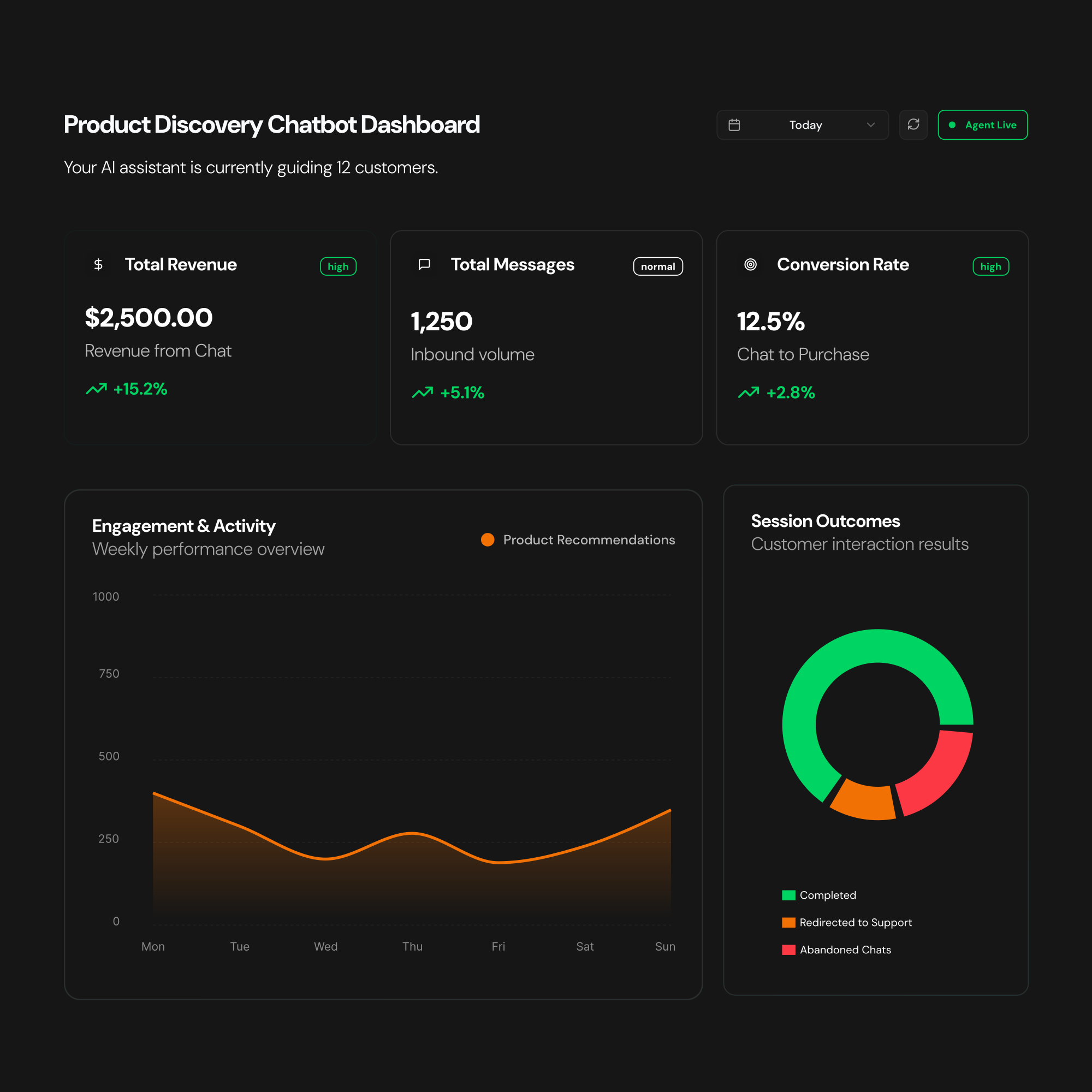
Netguru’s R&D team built Chatguru as a production ready foundation, not a prototype. Every architectural decision was designed to solve the reliability, flexibility, and implementation challenges teams faced with existing chatbot solutions.
The biggest challenge in deploying AI chatbots is keeping responses grounded in real and up to date business data. Instead of relying on generic model knowledge, Chatguru retrieves information directly from the client’s own product catalogs, policy documents, or knowledge bases before generating a response. This makes the platform suitable for environments where accuracy matters.
Because client data stays within the client’s own infrastructure, Chatguru can be used in regulated environments and industries handling sensitive information. Released under the MIT license, the platform removes vendor dependency and gives teams full ownership and flexibility over the implementation.
Rather than delivering only the AI backend, Netguru paired Chatguru with Silk, the company’s open source design system for commerce and marketplace products. Chatguru handles the conversational logic and AI infrastructure, while Silk provides reusable frontend components and interface patterns.
Together, they work like modular building blocks that allow teams to launch branded conversational experiences much faster instead of building both the backend and frontend from scratch.
The platform includes Langfuse for monitoring and tracing, pytest for testing, Promptfoo for LLM evaluation, and RAGAS for RAG quality evaluation. These tools are part of the default setup, helping teams continuously measure and improve chatbot performance over time.
Chatguru uses FastAPI and Uvicorn for the backend, LangChain with Azure OpenAI as the default LLM layer, sqlite-vec for vector search, React 19 and Vite for the frontend, and Docker for containerized deployment. The stack was selected for long term maintainability and real production environments rather than demo use cases.
Chatguru is a starting point, not a finished product. Its value is what it makes possible for the teams that build on it.
Chatbot for commerce teams: Chatguru supports product discovery through natural language instead of filter-based search, guides customers through buying decisions, automates pre-sales support questions about availability and compatibility, and handles post-purchase service interactions. It works across the full shopping journey, from first browse to repeat purchase.
Chatbot for healthcare organizations: RAG grounds every answer in verified clinical or administrative content. Patient navigation, appointment guidance, FAQ automation, and post-visit support can all run on real documentation rather than general AI knowledge, which is the only basis on which accuracy-critical healthcare interactions should operate.
Chatbot for insurance businesses: Policy discovery, coverage explanation, claims support, and renewal conversations all benefit from the same RAG foundation. When a customer asks what a specific clause covers, the answer comes from the actual policy document, not a language model’s approximation of what insurance policies tend to say.
1–2 months from kickoff to production, depending on integration and branding complexity.
At Netguru we specialize in designing, building, shipping and scaling beautiful, usable products with blazing-fast efficiency.
Let’s talk business
©2026 Netguru S.A. All rights reserved.
