
Welcome to the forefront of conversational AI as we explore the fascinating world of AI chatbots in our dedicated blog series. Discover the latest advancements, applications, and strategies that propel the evolution of chatbot technology. From enhancing customer interactions to streamlining business processes, these articles delve into the innovative ways artificial intelligence is shaping the landscape of automated conversational agents. Whether you’re a business owner, developer, or simply intrigued by the future of interactive technology, join us on this journey to unravel the transformative power and endless possibilities of AI chatbots.
How to Choose the Best AI Agent Development Company for Businesses
25+ Disruptive AI Agent Business Ideas You Should Launch in 2026
How to Hire the Best AI Developer for Your Custom Project? Key Steps, Costs, and More
How to Build an AI App? Steps, Features, Costs, Trends
AI in Transportation: Benefits and Use Cases for Modern Enterprises
How to Build an Intelligent AI Model: An Enterprise Guide
The Role of AI in the Oil and Gas Industry – 10 Use Cases, Benefits, Examples
AI in Real Estate: 16 Powerful Applications with Real Examples
AI in the Automotive Industry Transforms the Future of Business: Benefits and Use Cases
A leading digital platform to offer engaging shopping experience to users
A mobile app to digitalise & expand KFC’s digital footprint
The MIT Innovation award-winning app with $52 million funding reshaping the employment landscape.
A transforming ERP solution for the world’s largest furniture retailer
A refined UX strategy for Domino’s to increase their conversion rate by 23%
A SaaS-based financial literacy and smart money management platform for kids
10+ Ways AI Trading Agents are Optimizing Financial Markets
A Comprehensive Guide to Software Audit Services: Enterprise Risks, Governance Impact, and Strategic Use Cases
AI for Market Research: How Enterprises Reduce Product Launch Failure Before GTM
A Founder’s Guide to Dating App Development and Monetization Models
How to develop an LLM model? A comprehensive guide for enterprises
How Much Does It Cost to Build a Healthcare App?
InventivAI by Appinventiv: A New Era of Enterprise AI Innovation
Appinventiv Achieves AWS Advanced Tier Partner Status and Triple Competency Recognition
Appinventiv Leads the Next Wave of AI Innovation for Polish Enterprises
How Much Does it Cost to Build a Cloud Based Digital Signage Software?
10 Use Cases of How AR is Changing the Way Consumers Interact with Banking and Financial Services
How Much Does It Cost to Build an eCommerce App Like Jarir Bookstore?
Banking Technology Consulting: A Strategic Roadmap for Core Modernization and Guaranteed ROI
How to Build a Payment App Like Zain Cash?
8 Irresistible Reasons Why Business Should Invest in Mobile App
Key takeaways:
If you’ve ever watched a hotel lobby shift from calm to crowded in a matter of seconds, you know how quickly the smallest things start to matter. A guest who checks in without a long wait, a room that feels just right, or a staff member who remembers something from a past stay. These small moments decide how welcome a guest feels, even before they reach their room.
To keep those moments smooth, hotels are starting to bring in AI in hospitality as a quiet helping hand. Hilton’s use of Connie is a simple but telling example. A guest can walk over, ask about a good dinner spot or the gym timings, and get an answer right away. No waiting at the front desk and no digging for information. It clears small roadblocks and gives your team the breathing room to focus on guests who need real attention.
Behind the scenes, AI technology in the hospitality industry picks up on patterns that are easy to miss when operations get busy. It helps adjust schedules, sends helpful updates, and surfaces insights that usually take hours to notice. When it all blends naturally into daily work, your service feels more personal without asking your staff to stretch themselves thin. The real advantage is how it helps you deliver a stay that feels easy, thoughtful, and genuinely cared for.
If your teams are juggling peak-hour pressure, staffing gaps, and rising guest expectations, AI can quietly handle the small things so your people can focus on what really matters
Most hospitality leaders don’t wake up wanting “AI software.” They want fewer guest complaints during peak hours, cleaner handovers between shifts, and systems that stop lagging when the property is full. AI enters the picture only when existing processes start to strain.
This is how AI-based hospitality software is typically planned, built, and rolled out in real hotel environments.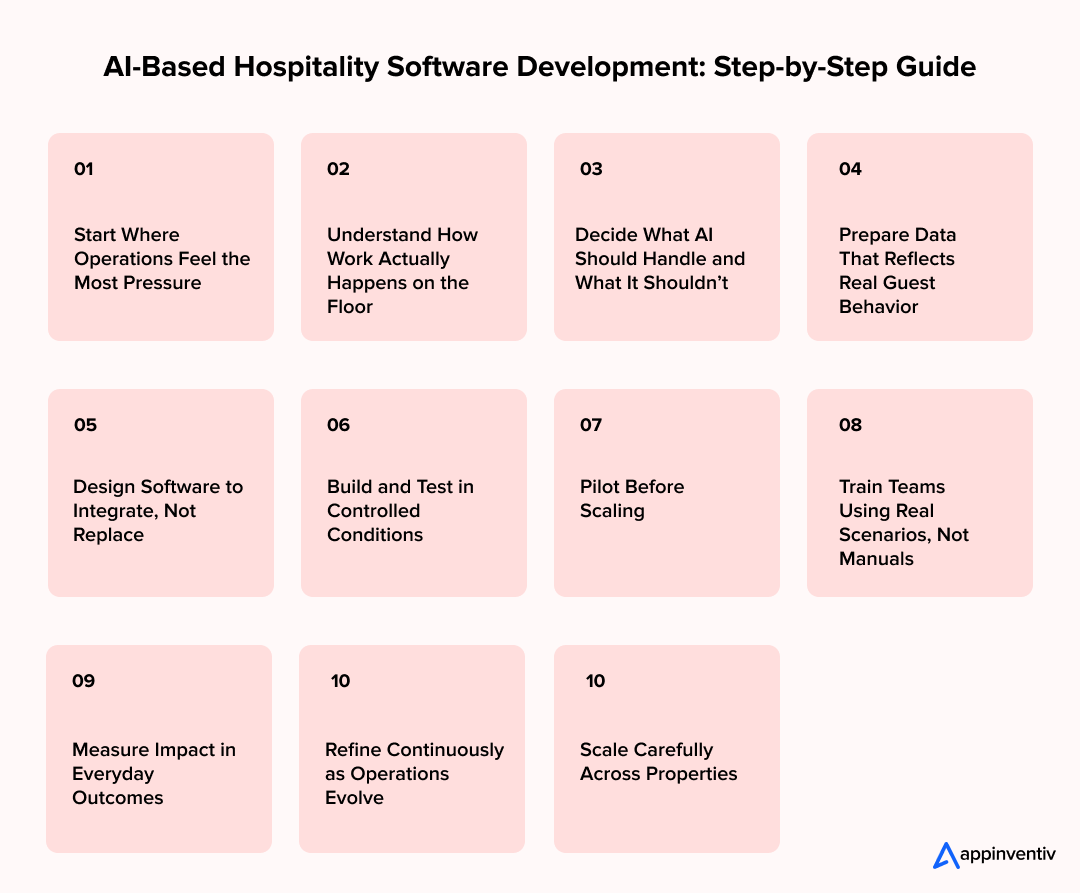
The first step is not choosing tools. It’s listening. AI projects usually begin when teams repeatedly hit the same friction points:
These moments tell you where AI can help without disrupting service.
Before defining features, development teams need a clear picture of day-to-day reality.
This means observing:
AI software only works when it supports these real workflows, not idealized ones.
Not every task should be automated. Some need visibility, others need support, and a few can run on their own.
Clear boundaries matter:
This clarity prevents AI from feeling intrusive and builds trust early.
Hotels already generate more data than they realize. The challenge is structure, not volume.
Development focuses on:
AI trained on realistic data adapts better to changing conditions.
Most hospitality environments rely on long-standing systems. Replacing them introduces risk.
AI-based hospitality software is built to:
If teams have to “switch contexts,” adoption drops quickly.
AI models are introduced gradually. One property, one department, one use case.
This phase helps teams:
Early success is about stability, not sophistication.
A focused pilot shows whether AI genuinely reduces pressure or just shifts it elsewhere.
Common pilot areas include:
Pilots create evidence that leaders can trust before a wider rollout.
AI adoption improves when staff understand why the system behaves the way it does.
Training works best when it:
Confidence grows when teams feel in control.
Success rarely shows up first in dashboards. It shows up in shifts.
Look for:
These changes signal real operational value.
Guest mix changes. Seasons shift. Events disrupt patterns. AI-based hospitality software needs:
AI stays useful only when it evolves alongside the business.
Once proven, the system can expand. But no two hotels run exactly alike. Successful scaling keeps:
This balance preserves both efficiency and flexibility.
The cost of building AI software for hospitality usually depends less on the idea and more on how deeply it needs to fit into daily operations. A simple system that handles a single function, such as guest communication or demand forecasting, sits at the lower end. Platforms that connect multiple departments and properties naturally cost more.
In most cases, AI hospitality software development falls between $40,000 and $400,000.
What typically shapes the cost:
Most hotels start small, prove value, and then expand. That approach keeps costs under control while ensuring the investment actually improves operations rather than adding complexity.
Most of the value AI brings to hospitality shows up in moments guests never think about. A shorter wait at the front desk. A room that’s ready when promised. A request that gets handled before it turns into a complaint. None of this feels like technology at work. It just feels like the hotel is running well.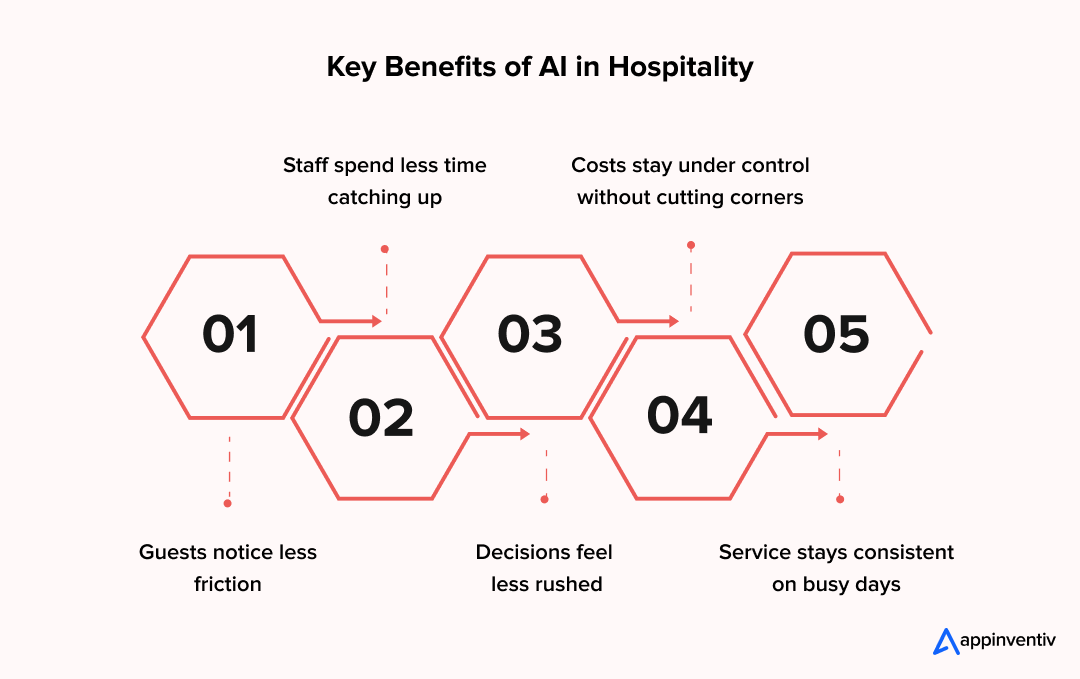
That’s where AI tends to help the most.
AI doesn’t change what hospitality is about. It simply helps the operation hold together when things get busy, which is usually when it matters most.
During peak hours at the front desk, operational pressure builds quickly. Check-ins overlap with guest requests, housekeeping coordination, and performance tracking. It’s in these moments that teams realize their current setup may not scale.
Below is the refined and expanded set of 30 AI use cases in hospitality, written in a grounded, practical tone so leaders can see how each one plays out in real operations.
AI-powered software for hospitality learns how equipment behaves before it fails through predictive analytics. Subtle changes in usage patterns or sensor data flag issues long before a guest reports a problem. This gives engineering teams time to intervene quietly rather than respond to urgent calls during busy periods.
The result is fewer service disruptions reaching guests. Maintenance becomes planned work instead of emergency work, which also reduces staff burnout. Over time, assets last longer, and maintenance costs become more predictable.
AI in hospitality monitors how guests respond during their stay. Dining choices, amenity usage, and timing all shape what gets recommended next. Suggestions change as the stay progresses rather than being fixed at booking.
Guests experience these recommendations as thoughtful rather than scripted. A well-timed suggestion often leads to a small but memorable moment. That sense of being understood is what drives repeat visits.
Conversational AI in hospitality removes friction in multilingual environments. Staff and guests communicate clearly in real time, even during high-pressure moments like billing questions or service recovery. Nothing gets lost in translation.
This builds confidence on both sides of the conversation. Staff do not hesitate or escalate unnecessarily, and guests feel respected. The experience stays calm, even when the situation is not.
AI in the hospitality industry tracks how the day unfolds. Early departures, extended stays, last-minute service requests, and delayed arrivals are all factored in as they happen. Room priorities shift automatically, instead of being locked into a morning plan that becomes outdated by noon.
For housekeeping supervisors, this removes constant firefighting. Teams spend less time walking back and forth or redoing schedules, and more time finishing rooms on time. Turnover stress during peak checkout windows drops because priorities stay aligned with reality.
AI-powered software for hospitality does not wait for post-stay surveys to surface problems. It reads in-stay messages, reviews drafts, and feedback signals as they form. When frustration starts to build, teams catch it early rather than discover it after checkout.
This allows service recovery to happen while it still matters. Small gestures or quick fixes often prevent negative reviews entirely. Guest experience management becomes proactive rather than damage control.
AI simplifies check-in by learning which steps slow guests down and which ones are usually repeated. Routine details are handled automatically, so arrivals move faster without losing personalization. The process feels smoother, not robotic.
For front desk teams, this changes the pace of the shift. Instead of rushing through forms, staff can focus on welcoming guests and answering real questions. Peak arrival periods feel more controlled and less chaotic.
AI in marketing watches how guests interact across booking, pre-arrival, and in-stay touchpoints. It learns what a guest responds to and when, instead of blasting the same message to everyone. Communication is triggered by behavior, not calendars.
Guests notice when messages feel relevant. Engagement improves because timing makes sense. Marketing stops feeling noisy and quietly supports the guest journey in the background.
AI-powered inventory management in hospitality systems learn consumption patterns across food, linens, amenities, and supplies. Instead of fixed reorder points, inventory decisions adjust based on upcoming demand and historical usage.
This reduces waste without risking shortages. Storerooms stay lean, and operations remain uninterrupted. Procurement becomes more predictable and less reactive. Nd less time fixing yesterday’s numbers and more time understanding today’s priorities.
It allows hospitality brands to showcase rooms, venues, and amenities through immersive, interactive experiences. Guests can explore spaces before booking, reducing uncertainty and improving decision-making.
When combined with AI-powered chatbots in hospitality, these tours deliver real-time, personalized assistance answering questions about pricing, availability, and amenities instantly. With AI automating 360-degree tour creation and chatbot-driven interactions, virtual tours become a powerful tool to boost engagement and drive bookings
AI in hospitality updates revenue forecasts as booking behavior shifts throughout the week. Cancellations, pickup speed, and pricing changes are reflected in near real time, not at fixed reporting intervals.
Leadership decisions stay aligned with reality. Pricing, staffing, and marketing adjust based on current signals instead of outdated assumptions. Forecasts become tools for action, not just reporting.
Most guests don’t want to learn another system when they enter a room. They just want things to work. Voice assistants fit naturally into that expectation. A guest can dim the lights while unpacking, adjust the temperature without getting out of bed, or ask for towels without calling the front desk.
It feels less like using technology and more like speaking to the room itself. For hotel teams, this quietly cuts down routine calls and lets staff focus on requests that actually need attention.
Long lines at check-in are rarely about impatience. They’re about fatigue. After travel, guests want to get to their room without friction. Contactless check-in, including facial recognition where appropriate, helps remove that last hurdle. Returning guests are recognized, details are confirmed, and access is granted with minimal interaction.
The experience feels smoother and more respectful of a guest’s time, while staff can shift their energy from processing paperwork to actually welcoming people.
Staffing is one of those things that looks simple on a schedule but feels very different on the floor. Some days, the lobby stays quiet longer than expected. Other days, arrivals pile up all at once. AI in the workforce helps by spotting these patterns early and adjusting schedules before teams feel the strain. Shifts line up more closely with how busy the hotel actually gets, not how busy it was supposed to be.
The result is fewer rushed moments, less overstaffing during slow hours, and teams that feel better supported when things pick up.
Housekeeping plans can fall apart quickly when guests check out early, extend their stay, or request service at odd times. AI helps keep things on track by updating room priorities as the day unfolds. Cleaners know which rooms matter most right now, not just what was planned in the morning.
Alerts surface when a room needs attention, and nothing gets missed between shifts. It doesn’t replace the team’s judgment. It simply keeps everyone aligned when the pace changes.
Security in a hotel is mostly about awareness, not confrontation. AI-powered surveillance or monitoring helps teams notice when something feels off without constantly watching screens. Unusual movement patterns, restricted-area access, or behavior that doesn’t match the time or location are quietly flagged for review. This gives security staff a heads-up early, while guests go about their stay without feeling observed or disrupted.
Fraud rarely announces itself. It shows up in small inconsistencies, unusual booking patterns, or transactions that don’t quite add up. AI in fraud detection helps spot these signs early by comparing activity against normal behavior across channels. Legitimate guests move through without friction, while suspicious bookings are reviewed before they turn into chargebacks or losses. For finance teams, this means fewer surprises after the stay is over.
Taken together, these AI use cases show how hospitality operations are becoming more adaptive, coordinated, and guest-focused without adding complexity. The value lies in removing friction from daily work while making decisions faster and more reliably.
Let’s move on to some real-world examples show how hospitality businesses are already applying these systems in live operations, where outcomes matter more than theory.
As the hospitality industry embraces digital transformation, AI in hospitality is playing a vital role in reshaping services and operations. Here are some real-world AI in the hospitality industry examples of leading brands that are successfully leveraging this technology to enhance their services and streamline their operations.
Hilton has been one of the more public examples with its AI-powered solutions in hospitality, including robotics like Connie at concierge desks that help answer guest questions and provide recommendations around the clock. This is part of a broader move to speed up responses and enrich guest experiences.
Marriott uses AI-powered software for hospitality, chatbots, and analytics to handle routine inquiries and tailor recommendations based on guests’ past stays. This helps not only in creating a smoother guest journey but also in boosting direct bookings and loyalty.
IHG has expanded its digital concierge and voice assistant offerings. Their platforms provide real-time travel help, smart room controls, and personalized suggestions that keep guests engaged and serviced through mobile apps.
In markets like Singapore, hotels are integrating AI in hospitality management across guest communications, housekeeping, predictive maintenance, and energy management. Some properties use IoT sensors and AI technology in the hospitality industry together to lower HVAC costs by up to 30 percent and free teams from manual monitoring.
It’s not just hotels. Travel firms like Tui are leveraging AI in travel and hospitality to generate engaging content, such as “inspirational” travel videos and voice/chat agents to support trip planning, bringing personalized, AI-powered solutions in hospitality into the broader travel journey.
When a hotel decides to bring AI into daily operations, a few practical checks can make the rollout much smoother.
Also Read: AI for Enterprise – Transforming Business with Intelligence
When a hotel starts exploring AI in hospitality, the first reaction is usually a mix of curiosity and a little excitement. Then reality steps in. Anyone who has tried introducing a new system during a fully booked week knows how quickly one small hiccup can slow down an entire shift. None of these challenges is a deal-breaker, but they do need a bit of attention before teams dive in.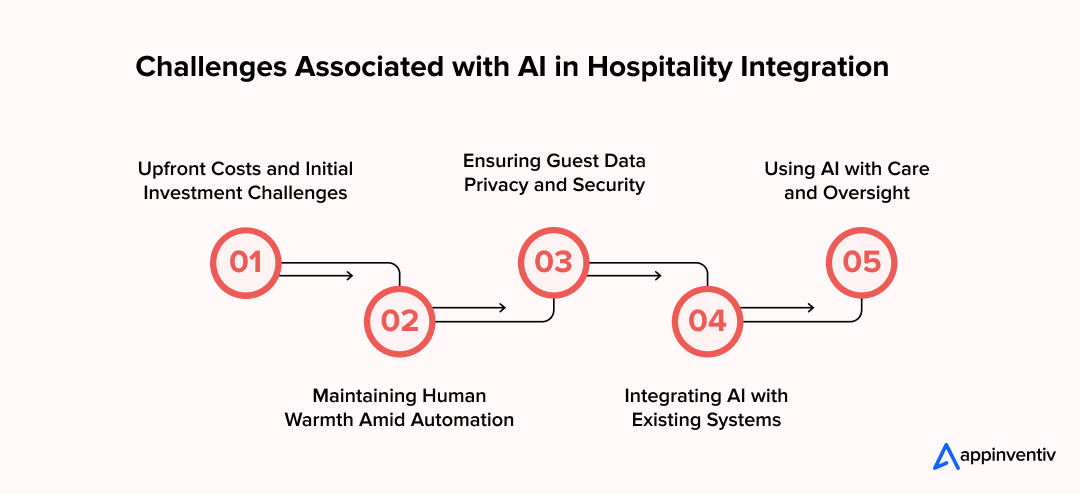
A growing number of hotels are managing costs by adopting AI as a Service (AIaaS) models that allow gradual scaling without heavy upfront investment. At Appinventiv, similar flexibility is achieved by designing customised AI engagements that let hospitality teams start small, validate value early, and scale capabilities in line with operational readiness.
The impact of AI in hospitality doesn’t show up as a dramatic change overnight. It shows up in how smoothly a hotel runs on busy days and how little guests notice when things could have gone wrong. When AI is used thoughtfully, it becomes part of the rhythm of daily operations rather than a visible layer of technology.
Some of the most meaningful impacts are easy to spot in practice:
The real impact of AI in hospitality is quiet. Guests feel looked after. Teams stay focused. And the operation holds together when it matters most.
Spend a little time with a hotel team, and you can sense a quiet shift happening. Guests expect things to feel smoother, a little more personal, and far less manual. AI in hospitality is slowly finding its place in that world, not as something flashy, but as a set of tools that help properties deliver those small touches guests remember.
Here is how this evolution is starting to show up in real ways:
Picture a room that adjusts itself without a guest touching a thing. Lights soften in the evening, playlists change with the weather, and dining ideas pop up that actually match what the guest likes. Generative AI in hospitality is bringing that level of intuition into hotels. It can even help create custom travel guides or make conversations easier for guests who prefer a different language.
With IoT devices quietly talking to each other, hotels don’t need to ask guests about every preference. Temperature, lighting, and even blinds can shift based on patterns the system notices. The goal isn’t to impress guests with gadgets. It’s to make the room feel comfortable without effort. The amalgamation of IoT and artificial intelligence in the hospitality industry will help enhance the overall comfort without guest intervention.
More travelers want certainty when choosing a room. Virtual walk-throughs give them a sense of space, views, and amenities long before they arrive. It feels a bit like visiting the property early, just enough to build confidence in their choice.
Behind the scenes, hotels deal with constant changes. Occupancy rises, and dips, staff availability shifts, and operational costs move with it. AI in the hospitality industry can keep track of all this in real time and highlight what needs attention. A small suggestion at the right time can save hours of scrambling later.
As guests grow more comfortable talking to voice assistants at home, using one in a hotel room feels natural. Asking for towels, adjusting the temperature, or getting a quick answer becomes easier. And it frees up staff for things that need a personal touch.
Instead of sending broad offers, AI in hospitality can help hotels understand what past guests actually enjoyed. Messages feel more tailored and less like a blast sent to everyone.
Hotels often discover issues after a guest has left. With AI tools watching reviews and comments in real time, teams can step in while the guests are still on the property. Fixing something immediately often turns a neutral stay into a memorable one.
We hope our blog helped you understand the importance of AI for your hospitality business. As a dedicated AI software development company, we can help you enhance your hospitality services with artificial intelligence, drawing on our robust experience and portfolio of successful AI projects. Our team is proficient in the latest AI trends and technologies, designing solutions that integrate seamlessly into your existing operations to boost both efficiency and guest satisfaction.
Additionally, our experts are also skilled in deploying AI applications that can transform guest experiences and streamline backend operations for your business. We can help you develop smart systems for personalized room environments, efficient data-processing software for strategic decision-making, and AI chatbots for real-time customer service enhancements.
S Our AI work spans industries where reliability, personalization, and real-time decision-making are critical. For flynas, we built AI-led data-driven systems to support operational intelligence and customer experience at scale. With MyExec and VYRB, we delivered AI-powered solutions that streamline workflows and enable intelligent, personalized engagement, demonstrating our ability to deploy AI systems in live, complex environments.
Get in touch to equip your hospitality business with software that meets current technological standards and sets new benchmarks for personalized service.
Q. Which AI agents are top in hospitality?
A. Some of the best AI agents in hospitality applications today are designed to make guest experiences smoother and more personalized. Take Hilton’s Connie, for example. It’s an AI-powered concierge that’s available 24/7 to help guests with everything from restaurant suggestions to local activities. These kinds of AI applications in the hospitality industry are popping up everywhere, from chatbots answering common questions to voice-activated systems enhancing in-room services.
Q. How Appinventiv Helps Hospitality Brands Build Tailored AI Solutions
A. At Appinventiv, we specialize in custom AI software development for the hospitality industry. We help hospitality brands develop AI-powered solutions in hospitality that elevate guest experiences, streamline operations, and improve business efficiencies. Our expertise extends to AI in Hospitality app development and AI-based Hospitality Software Development, ensuring seamless integration of conversational AI in hospitality to enhance guest interactions and back-end processes.
Q. How is AI used in the hospitality industry?
A. The use of AI in the hospitality industry is growing rapidly, and its applications are varied. From AI customer service in hospitality, like chatbots and AI-driven concierge services, to AI automation in hospitality, AI is used for managing operations, guest preferences, and dynamic pricing. AI in the hospitality industry helps hotels improve operational efficiency and deliver personalized services that make guests feel valued.
Q. How to choose AI Tools for Your Hospitality Business?
A. When selecting AI tools for your hospitality business, it’s crucial to focus on solutions that align with your operational needs. Tools like AI-powered software for hospitality automate everything from check-ins to personalized guest interactions. Integrating AI into hospitality software development is a smart move, allowing you to optimize processes, increase engagement, and improve guest satisfaction with minimal effort.
Q. How Appinventiv’s Enterprise AI Platform Is Powering the Future of Hospitality?
A. Appinventiv’s enterprise AI platform for hospitality helps businesses build AI-powered solutions in hospitality that scale effectively. With our expertise in AI in Hospitality app development and AI-based Hospitality Software Development, we ensure smooth integration of AI automation in hospitality to enhance guest interactions and streamline hotel operations. Our platform provides smart solutions that meet the evolving demands of the hospitality industry.
Q. How much does it cost to develop an AI Hospitality Software app?
A. The cost of developing an AI Hospitality app can vary depending on complexity, features, and integrations. Typically, developing AI-powered hospitality software can range anywhere from $40,000 to $400,000. The investment depends on what you need whether it’s AI-driven customer service, predictive maintenance, or personalized guest experiences, AI in hospitality can offer significant ROI in the long run.
Q. Can AI replace human employees in the hospitality industry?
A. While AI in hospitality can automate routine tasks, like guest check-ins, inquiries, and room adjustments, it doesn’t replace the need for human interaction. Instead, AI automation in hospitality frees up hotel staff to focus on more personal guest experiences. AI tools like conversational AI in hospitality help guests while supporting staff in delivering better service.
Q. How can AI improve guest experiences in hotels?
A. AI-powered solutions in hospitality can improve guest experiences by offering personalized recommendations based on past stays and preferences. Through the use of AI in the hospitality industry, guests can enjoy smart room features, personalized dining suggestions, and efficient check-ins. AI in the hospitality industry ensures every aspect of the stay feels seamless and tailored.
Q. What to expect from AI in the hospitality industry in 2026?
A. In 2026, AI in hospitality is expected to be fully integrated into the guest experience. AI trends in the hospitality industry in 2026 will center on improving personalization and operational efficiency. Expect AI to play an even larger role in AI-powered software for hospitality, including AI-driven automation of housekeeping and maintenance schedules. The future of AI in hospitality will also see advancements in AI-based Hospitality Software Development and AI in Hospitality app development, further enhancing the guest experience.
Chirag Bhardwaj is a technology specialist with over 10 years of expertise in transformative fields like AI, ML, Blockchain, AR/VR, and the Metaverse. His deep knowledge in crafting scalable enterprise-grade solutions has positioned him as a pivotal leader at Appinventiv, where he directly drives innovation across these key verticals. Chirag’s hands-on experience in developing cutting-edge AI-driven solutions for diverse industries has made him a trusted advisor to C-suite executives, enabling businesses to align their digital transformation efforts with technological advancements and evolving market needs.
10+ Ways AI Trading Agents are Optimizing Financial Markets
Key takeaways: AI trading agents now outperform traditional systems, delivering faster decisions, cleaner execution, and stronger risk control. Institutions are adopting AI in algorithmic trading at scale, driven by real-time insights, automation, and 24/7 global coverage. AI enhances market efficiency through predictive analytics, sentiment analysis, arbitrage detection, and high-frequency trading optimization. Challenges like model bias,…
AI for Market Research: How Enterprises Reduce Product Launch Failure Before GTM
Key takeaways: Most product launches fail because market assumptions break under real conditions, not because the product itself is weak. Go-to-market risk accumulates through small, rational decisions that compound when assumptions are never challenged early. AI transforms market research from plan validation into continuous detection of demand, pricing, and positioning risks. AI insights reduce launch…
Why Private AI Is the Future of Ethical and Secure AI Adoption for Enterprises?
Key takeaways: $109.1 billion was invested in global private AI in 2024, demonstrating enterprises’ commitment to secure AI. Private AI keeps data within your infrastructure for complete control; public AI processes data externally on shared cloud platforms. Private AI enables enterprises to scale AI responsibly with complete data sovereignty, regulatory compliance, and superior long-term economics…
Digital product consulting, development, and engineering company.
B-25, Sector 58, Noida –
201301,
Delhi-NCR, India
79 Madison Ave,
Manhattan,
NY 10001, USA
96 Cleveland Street,
Stones Corner,
QLD 4120
3rd Floor, 86-90
Paul Street EC2A 4NE
London, UK
Meydan Grand Stand,
6th floor, Meydan road,
Nad AI Sheba, Dubai
Suite 3810, Bankers Hall
West,
888 – 3rd Street Sw,
Calgary Alberta
Appinventiv is the Registered Name of Appinventiv Technologies Pvt. Ltd., a mobile app development company situated in Noida, U.P. India at the street address – B- 25, Sector 58, Noida, U.P. 201301.
All the personal information that you submit on the website – (Name, Email, Phone and Project Details) will not be sold, shared or rented to others. Our sales team or the team of mobile app developers only use this information to send updates about our company and projects or contact you if requested or find it necessary. You may opt out of receiving our communication by dropping us an email on – info@appinventiv.com
1600+ transformation engineers delivered
3000+ game-changing products.
Connect with our consultation experts to get:
Insights specific to your business needs
Roadmap to overcome your challenges
Opportunities to scale your business in this niche.