
Welcome to the forefront of conversational AI as we explore the fascinating world of AI chatbots in our dedicated blog series. Discover the latest advancements, applications, and strategies that propel the evolution of chatbot technology. From enhancing customer interactions to streamlining business processes, these articles delve into the innovative ways artificial intelligence is shaping the landscape of automated conversational agents. Whether you’re a business owner, developer, or simply intrigued by the future of interactive technology, join us on this journey to unravel the transformative power and endless possibilities of AI chatbots.
How to Choose the Best AI Agent Development Company for Businesses
25+ Disruptive AI Agent Business Ideas You Should Launch in 2025
How to Hire the Best AI Developer for Your Custom Project? Key Steps, Costs, and More
How to Build an AI App? Steps, Features, Costs, Trends
AI in Transportation: Benefits and Use Cases for Modern Enterprises
How to Build an Intelligent AI Model: An Enterprise Guide
The Role of AI in the Oil and Gas Industry – 10 Use Cases, Benefits, Examples
AI in Real Estate: 16 Powerful Applications with Real Examples
AI in the Automotive Industry Transforms the Future of Business: Benefits and Use Cases
A leading digital platform to offer engaging shopping experience to users
A mobile app to digitalise & expand KFC’s digital footprint
The MIT Innovation award-winning app with $52 million funding reshaping the employment landscape.
A transforming ERP solution for the world’s largest furniture retailer
A refined UX strategy for Domino’s to increase their conversion rate by 23%
A SaaS-based financial literacy and smart money management platform for kids
Identity and Access Management in Healthcare: Core Components, Challenges, and Best Practices
Decentralized Exchange (DEX) Development: Features, Implementation Cost, and Enterprise ROI
How to Develop Risk Management Software in Australia – Process, Cost, ROI
How to develop an LLM model? A comprehensive guide for enterprises
How Much Does It Cost to Build a Healthcare App?
How Much Does It Cost to Build an AI Product?
InventivAI by Appinventiv: A New Era of Enterprise AI Innovation
Appinventiv Achieves AWS Advanced Tier Partner Status and Triple Competency Recognition
Appinventiv Leads the Next Wave of AI Innovation for Polish Enterprises
Scaling LLMs for Enterprise Applications: The LLMOps Approach
How to Integrate AI in EHR/EMR Systems for Streamlined Healthcare Operations
Financial Fraud Detection Using Machine Learning: A Comprehensive Guide
Healthcare Data Warehousing Benefits and Use Cases – Centralizing Data for Improved Patient Care
White Label Carbon Management Software Development Costs – A Detailed Analysis
How Much Does It Cost to Develop a Food Delivery App like Glovo?
The speed at which fintech transformation is happening is nothing short of a never-seen-before revolution. With the advent of technologies like blockchain, artificial intelligence, metaverse, and edge computing, the fintech space – as we know it – has drastically changed. This transformation’s intrinsic change can be seen in how comfortable users have gotten with on-the-move transactions, single-click investments, low-effort loan approvals, and the sudden rise in new business models like BNPL and sachet insurance.
While on the customers’ end, tech inclusion has been all about high efficiency and improved lives, traditionally operative banks continue to show signs of struggle. At a time when banks are busy creating and implementing plans for lowering the unbanked population globally, this sudden need for digital transformation comes as an added pressure. However, if market movements are true, this struggle is short-lived, especially with machine learning here to take banks out of this slump.
Let’s dive into it in this article, where we will approach machine learning in banking industry insights in two-fold – use cases and implementation.
With a market size that is poised to reach $21.27 billion by 2031, machine learning in banking and finance is definitely happening. With use cases being only slightly different from new-gen fintech products, the core functionality remains the same.
Machine Learning in banking industry works best for pattern identification. They can detect correlations in tons of events and sequences, extracting key information that’s often camouflaged inside massive data sets – something that is easily missed by humans. While seemingly small, this opens doors to a wide range of use cases and applications that have far-reaching outcomes in both micro and macro environment levels.
The ability of ML in the banking industry to learn and predict enables institutions to recognize new business opportunities and work out coherent strategies.
Now that we have a brief overview of how the technology fits into the domain, let us get to the applications part. For this, we will be dividing the use cases of machine learning in banking into two parts – individual banks and the global banking sector as a whole.
In an increasingly digital landscape, machine learning in the banking industry is being applied to enhance both operational efficiency and customer experience. From automating back-office processes to personalizing front-office services, ML technologies are transforming the way financial institutions operate.
In this section, we will explore some key use cases within back-office and front-office functions, highlighting real-world examples that illustrate how banks are successfully implementing these innovative solutions to improve their services and maintain regulatory compliance.
Let’s delve into specific use cases categorized by essential operational functions within financial institutions, starting with back office.
Document digitization refers to the transformation of physical records into digital formats like PDFs or images to text, facilitating easier storage, access, and management. AI-driven Optical Character Recognition technological tools like image to text are pivotal in this process, enabling the extraction of text and data from scanned documents. Additionally, Robotic Process Automation can be used to assist in populating data from multiple sources.
On the other end of the coin, there is document processing, which involves the analysis and interpretation of these digitized files to extract pertinent information, verify data accuracy, and take necessary actions based on the document’s content. Algorithms built for implementing machine learning in banking and finance can streamline various document processing tasks, including classification, extraction, validation, and routing.
Document processing using OCR is evolving rapidly, with computer vision solutions for FinTech offering advanced capabilities in automated document analysis and verification.
Example in Practice
Deutsche Bank utilizes AI technologies to streamline manual operations and enhance the classification, extraction, and validation of documents in both back-office functions and customer advisory services. A few of the notable applications include accelerating the traditionally labor-intensive loan document processing using OCR, leveraging AI for portfolio optimization in Wealth Management, and scrutinizing transactions for signs of financial misconduct.
The bank is dedicated to harnessing AI’s capabilities responsibly, ensuring fairness in banking algorithms, and striving for results that are accurate and explainable.
The monitoring of transactions and analysis of data to identify suspicious activities is crucial for compliance in the banking sector, especially for regulations aimed at combating money laundering and terrorist financing. Machine Learning algorithms are instrumental in this use case for automating the identification of suspicious patterns and anomalies in transaction data.
Example in Practice
Standard Chartered Bank employs Machine Learning-driven transaction monitoring systems to bolster its Anti-Money Laundering initiatives and meet regulatory standards. The bank also leverages AI and ML to automate several manual processes and better understand their customer behavior, allowing for an overall more tailored customer experience.
Next, let’s explore applications that have a direct impact on customer-facing interactions, products, and services in the banking industry.
According to a recent report, by the end of 2024, 33.2% of adult consumers in the U.S. are expected to engage with AI-enabled banking chatbots. This surge in popularity can be attributed to several advantages chatbots provide, such as:
– Round-the-clock availability
– Immediate responses
– Assistance with transactions
– Continuous learning from user interactions
Example in Practice
Bank of America has made significant strides in the financial sector with Erica, an AI-driven virtual assistant that offers personalized financial advice and support, enhancing customer service and loyalty.
Erica distinguishes itself by utilizing cutting-edge technologies, including advanced analytics and cognitive messaging, to function as a reliable financial advisor. It analyzes various data points from Bank of America, such as a customer’s cash flow, account balances, transaction history, and upcoming bills, helping clients manage their finances effectively.
Machine Learning algorithms assess customer data – ranging from transaction histories to spending behaviors – to create tailored product suggestions and offers. These personalized recommendations are increasingly vital in the banking industry, allowing institutions to cater to the distinct preferences and requirements of individual clients, especially when there are studies that indicate that 78% of banking consumers desire personalized support from their banks.
Example in Practice
Wells Fargo employs Machine Learning engines through its Customer Engagement Engine, which provides relevant product and service recommendations to customers. This solution enhances cross-selling opportunities and boosts customer satisfaction by identifying client needs and delivering what they term ‘next best conversations’ in real-time.
As the banking sector evolves, machine learning is becoming a cornerstone of innovation, enhancing operational efficiency and customer experience. From detecting fraud and preventing money laundering to optimizing compliance and personalizing customer service, ML technologies are reshaping the landscape. This section explores various impactful use cases and machine learning in banking examples highlighting how institutions leverage these tools to address challenges, improve decision-making, and stay competitive in a rapidly changing environment.
As cybercriminals continuously evolve their tactics, banks must enhance their defenses against financial crimes such as fraud and money laundering. Implementing fraud detection in banking using machine learning enables banks to identify malicious activities swiftly, verify user identities, and respond effectively to cyber threats.
ML algorithms can also process vast amounts of transaction data in real time, significantly reducing the need for human intervention. These systems are built to quickly recognize suspicious activities, alerting security teams or automatically blocking fraudulent transactions.
Notable startups in this space of banking machine learning use cases include:
Machine learning plays a pivotal role in enhancing Anti-Money Laundering initiatives by analyzing extensive financial data to identify patterns indicative of illicit activities.
The algorithms can automatically detect unusual transaction behavior, flagging it for further investigation by learning users normal transaction patterns and identifying anomalies such as large or rapid transactions and activity directed towards high-risk jurisdictions. Additionally, they can unveil complex money laundering schemes, including layering techniques and smurfing, which obscure the origins of funds.
Banks can also apply the tech to create dynamic risk profiles by assessing customer data and transaction history, helping identify high-risk clients and allocate resources effectively.
One example of an innovative ML application for AML is Google Cloud’s Anti-Money Laundering AI, which generates customer risk scores based on transactional and KYC data.
Financial institutions worldwide face constant pressure to adhere to changing regulations, often leading to operational disruptions and potential fines. Machine learning offers a solution to this by processing regulatory documents and detecting correlations between guidelines, enabling institutions to respond promptly to legal changes.
Startups working for this lot of machine learning banking use cases include:
[Also Read: How to develop a PCI-compliant application?]
With financial institutions inundated with support requests, machine learning can streamline and enhance customer service processes. By analyzing vast datasets, ML enables personalized assistance and targeted offers, improving customer experiences. Chatbots are the tools which tend to exemplify this application of machine learning in the banking sector, providing real-time, human-like support that evolves with each interaction.
The technology ultimately reduces the need for extensive customer support departments, benefiting both large and small financial institutions.
Prominent live examples of retention-specific machine learning banking use cases include:
Another of the key benefits of machine learning in banking can be seen in the tech offering powerful tools for predicting stock market dynamics by analyzing extensive historical datasets alongside real-time data. ML algorithms can also forecast stock prices and market trends, aiding traders in developing algorithmic trading systems.
Examples of ML applications for stock predictions include:
[Also Read: How AI is transforming the stock trading market]
Machine learning is reshaping investment strategies by uncovering patterns in historical and real-time financial data. This data-driven approach engines predictive analytics, which provides investors deeper insights into market movements.
Additionally, in algorithmic trading, ML automates trades based on learned strategies, allowing for rapid adaptation to market changes. Lastly, it also aids in portfolio optimization by adjusting asset allocations based on risk tolerance and market conditions.
Companies utilizing ML for investment strategies include:
Machine learning has the potential to significantly enhance risk assessment processes in banking, particularly in credit scoring. By analyzing diverse data sources, like rent payments and telecommunications data, ML algorithms can provide a comprehensive risk profile for loan applicants in a matter of a few minutes.
Notable examples of companies exploring machine learning in banking industry for credit scoring include:
With the use cases of machine learning for banks now explored, it goes without saying that the success would depend entirely on how the technology gets implemented in the banking domain. Let’s look into that in the next section.
Successfully integrating machine learning into banking operations requires a strategic approach that aligns with your organization’s goals. The steps we will be talking about can help facilitate the implementation process, from identifying specific business cases to preparing your data and understanding the algorithms at play.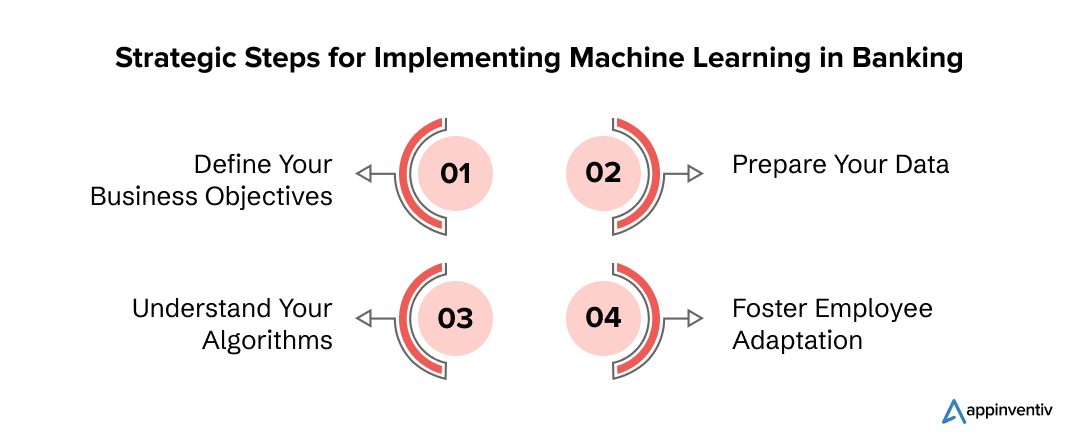 Each step of the machine learning for banks implementation emphasizes on the importance of collaboration and communication across the organization, ensuring that employees are equipped to adapt to this transformative technology. By following this, or similar, structured roadmap, banks can effectively leverage machine learning to enhance operations, improve customer experiences, and drive innovation.
Before diving into machine learning implementation, bank leaders should start by clearly defining their strategic goals. This understanding of how ML can support these objectives is crucial for not just maintaining clear communication of the vision throughout the organization but also for managers to identify specific ML opportunities within their divisions.
No matter what the vision is, it’s advisable to focus on quick wins – easy-to-implement solutions that demonstrate fast returns on investment. This approach can help uncover technological challenges and facilitates the development of a long-term ML strategy.
The effectiveness of machine learning is heavily dependent on the quality of the data used. Banks, at all times, should prioritize data accuracy and compliance with relevant regulations to prevent issues such as data breaches, which can severely damage customer trust.
To ensure high data quality, banking institutes can adopt the following practices:
It’s essential for banks to familiarize themselves with various machine learning algorithms and their implications. In our experience, understanding how different algorithms function, including their strengths and weaknesses, can significantly influence decision-making when looking at the risk-reward of the use cases of machine learning in banking.
The introduction of machine learning in the banking industry can create uncertainty among employees, leading to concerns about job security or skepticism regarding the initiative’s longevity. To ensure a smooth transition, organizations must create a clear vision and roadmap for integrating ML into daily operations.
Some of the key strategies to smoothen out the process can include:
To see this through, employees will need to adapt to new roles as the facilitators of machine learning:
If there’s anything (or two things) that we would like to present as a summary here, they are – A. The use cases or benefits of machine learning in banking are too big to ignore. B. The implementation of machine learning in the banking sector is easier read than done.
This is where Appinventiv, as a banking software development company, comes into the picture.
With an experience of working with multiple US and Middle East regional banks on their journey towards the exploration of the impact of machine learning in banking, we have an in-depth experience into not just helping banks transform digitally but also scaling up with the inclusion of next-gen technologies like AI-ML, Blockchain, Advanced Computing implementation, etc.
Our team of machine learning services providers have all the necessary skill sets to build a software or process that helps banks come at par with the digital movements of the current world. The result can be seen through a series of laudable stats ranging from a 60% reduction in fraudulent transactions to a 50% decrease in loan approval times, showcasing our impact on efficiency, security, and customer satisfaction in the banking sector.
Looking for similar results? Get in touch with the banking software development company that the world trusts, today.
Q. What is machine learning in banking?
A. Machine learning in banking industry refers to the use of algorithms and statistical models to analyze and interpret complex data sets, enabling financial institutions to make data-driven decisions.
By leveraging historical data, machine learning can identify patterns, predict outcomes, and automate processes, thereby enhancing efficiency, reducing risks, and improving customer experiences. The application of this can be seen in areas such as credit scoring, fraud detection, customer service, and regulatory compliance.
Q. How can machine learning be used in banking?
A. The use cases of machine learning in banking can be seen along several impactful ways, including:
Q. What can be one prime example of machine learning in banking?
A. A notable example of machine learning in banking sector is the use of predictive analytics for credit scoring. Financial institutions can analyze a wide range of data points, including transaction history, social media activity, and even behavioral patterns, to assess a borrower’s creditworthiness.
A real world example of this set of machine learning use cases in banking can be seen through ZestFinance, which utilizes machine learning algorithms to create more accurate credit models, enabling them to approve loans for individuals who may have been overlooked by traditional scoring methods.
Chirag Bhardwaj is a technology specialist with over 10 years of expertise in transformative fields like AI, ML, Blockchain, AR/VR, and the Metaverse. His deep knowledge in crafting scalable enterprise-grade solutions has positioned him as a pivotal leader at Appinventiv, where he directly drives innovation across these key verticals. Chirag’s hands-on experience in developing cutting-edge AI-driven solutions for diverse industries has made him a trusted advisor to C-suite executives, enabling businesses to align their digital transformation efforts with technological advancements and evolving market needs.
10 Use Cases and Examples of How Machine Learning is Transforming the Logistics Industry
The widespread adoption of ML has resulted in the explosion of data from sensors, customer interactions, and digital platforms across different domains. More and more businesses are leveraging machine learning in logistics to improve their strategic decision-making expertise centered around tailoring customer experience, improving productivity, increasing engagement, and preventing fraud. According to the McKinsey Global…
How Machine Learning in Retail is Redefining the Sector: Key Applications, Challenges, and Implementation Strategies
Key takeaways: Machine learning in retail is reshaping the industry through smarter recommendations, dynamic pricing, and real-time personalization. AI & ML deliver measurable ROI, helping brands boost conversions by up to 40% and unlock multiple operational advantages. Successful ML implementation in retail requires high-quality data, scalable infrastructure, and continuous model optimization. With 10+ years of…
10 Use Cases and Examples of How Machine Learning is Used in Manufacturing
Key takeaways: Machine learning is revolutionizing manufacturing with real-time, data-driven decision-making. ML reduces downtime, streamlines supply chains, and improves product quality through predictive analytics and automation. Industry leaders like General Motors, Siemens, and Adidas use ML for predictive maintenance, digital twins, and mass customization. ML is driving efficiency across sectors like automotive, food & beverage,…
Digital product consulting, development, and engineering company.
B-25, Sector 58, Noida –
201301,
Delhi-NCR, India
79 Madison Ave,
Manhattan,
NY 10001, USA
96 Cleveland Street,
Stones Corner,
QLD 4120
3rd Floor, 86-90
Paul Street EC2A 4NE
London, UK
Meydan Grand Stand,
6th floor, Meydan road,
Nad AI Sheba, Dubai
Suite 3810, Bankers Hall
West,
888 – 3rd Street Sw,
Calgary Alberta
Appinventiv is the Registered Name of Appinventiv Technologies Pvt. Ltd., a mobile app development company situated in Noida, U.P. India at the street address – B- 25, Sector 58, Noida, U.P. 201301.
All the personal information that you submit on the website – (Name, Email, Phone and Project Details) will not be sold, shared or rented to others. Our sales team or the team of mobile app developers only use this information to send updates about our company and projects or contact you if requested or find it necessary. You may opt out of receiving our communication by dropping us an email on – info@appinventiv.com
1600+ transformation engineers delivered
3000+ game-changing products.
We chose Appinventiv to build our financial literacy and money management app from start to finish. From the first call, we were very impressed with Appinventiv’s professionalism, expertise, and commitment to delivering top-notch results.
It has been a pleasure working with Appinventiv. The team is not only extremely versatile and competent but also very professional, courteous, and responsive. We certainly plan to continue working with Appinventiv for an indefinite period.
We took a big leap of faith with Appinventiv who helped us translate our vision into reality with the perfectly comprehensive Edamama eCommerce solution. We are counting to get Edamama to launch on time and within budget, while rolling out the next phase of the platform with Appinventiv.
I just want to take a moment to thank the entire Appinventiv team for your incredible support. We truly appreciate everything you’ve done, and we’re excited to continue working together as we grow here at KODA
After researching numerous companies, we finally found Appinventiv, and it was the best decision we could have made. They successfully addressed the challenges with our existing app and provided solutions that exceeded our expectations.
We approached Appinventiv with a clear vision to build a robust and future-ready platform that could seamlessly integrate with the busy lifestyle of our customers while uplifting their overall experience and giving us a competitive edge.
Transformation
Engineers Delivered
Game-changing
Products
Connect with our consultation experts to get:
Insights specific to your business needs
Roadmap to overcome your challenges
Opportunities to scale your business in this niche.