
Welcome to the forefront of conversational AI as we explore the fascinating world of AI chatbots in our dedicated blog series. Discover the latest advancements, applications, and strategies that propel the evolution of chatbot technology. From enhancing customer interactions to streamlining business processes, these articles delve into the innovative ways artificial intelligence is shaping the landscape of automated conversational agents. Whether you’re a business owner, developer, or simply intrigued by the future of interactive technology, join us on this journey to unravel the transformative power and endless possibilities of AI chatbots.
How to Choose the Best AI Agent Development Company for Businesses
25+ Disruptive AI Agent Business Ideas You Should Launch in 2025
How to Hire an AI Developer: The Complete 2025 Guide (Without Losing $500K in the Process)
How to Build an AI App? Steps, Features, Costs, Trends
AI in Transportation: Benefits and Use Cases for Modern Enterprises
How to Build an Intelligent AI Model: An Enterprise Guide
The Role of AI in the Oil and Gas Industry – 10 Use Cases, Benefits, Examples
AI in Real Estate: 16 Powerful Applications with Real Examples
AI in the Automotive Industry Transforms the Future of Business: Benefits and Use Cases
A leading digital platform to offer engaging shopping experience to users
A mobile app to digitalise & expand KFC’s digital footprint
The MIT Innovation award-winning app with $52 million funding reshaping the employment landscape.
A transforming ERP solution for the world’s largest furniture retailer
A refined UX strategy for Domino’s to increase their conversion rate by 23%
A SaaS-based financial literacy and smart money management platform for kids
10+ eCommerce Business Ideas to Launch in Australia in 2026
How Telemental Health Is Proving to be a Cost-Effective Solution for Healthcare Providers and Patients
Why AI is Essential for Modern Sales Forecasting – Benefits, Use Cases, Examples
How to develop an LLM model? A comprehensive guide for enterprises
How Much Does It Cost to Build a Healthcare App?
How Much Does It Cost to Build an AI Product?
Appinventiv Launches ASIC-Aligned Framework to Support Compliance and Innovation in Australian Finance
Appinventiv Now an Approved ICT Supplier Across All Levels of Australian Government
NSW AI Assessment Framework in Action: How Appinventiv is Enabling Compliant, Ethical AI in Every Stage
How Much Does It Cost to Build a Crypto Payment Gateway like BitPay?
How Much Does It Cost to Develop a Wayfair Like App?
Building Energy Management Systems for Carbon Neutrality
A Step-by-Step Guide On Mobile App Development Process
How Much Does it Cost to Develop an App like Adidas?
Telepharmacy Software Development – The Why’s And How’s
Key Takeaways
Rising costs. Labor shortages. Unpredictable demand. Fierce competition.
Sound familiar? If you’re running a QSR (Quick Service Restaurant) chain, managing cloud kitchens, or leading a food delivery platform, you know these aren’t just challenges; they’re your daily reality.
So here’s what really matters: How are you overcoming these barriers and staying ahead? The answer isn’t just grabbing whatever technology looks shiny. It’s about strategically implementing artificial intelligence across your food delivery operations.
We’re talking systems and applications that predict demand spikes before they smack you, optimize delivery routes in real time, personalize every customer touchpoint without manual work, and automate quality checks at massive scale.
This isn’t futuristic fantasy anymore. It is AI in action and your competitors are already rushing to AI in food delivery app development.
For CEOs and CTOs in the food and beverage sector, AI powered app development has moved beyond the “nice-to-have” category. It’s about embedding intelligence into the very architecture of your operation to enhance efficiency, eliminate waste, and cultivate a legion of delighted customers. These are all the powerful drivers of your bottom line.
But where do you actually start? How do you move from theory to a fully developed and deployed solution? Not sure what a proven AI development process looks like that can help you reap real results? Well, this blog is your go-to guide. It will take you through everything, from practical AI features you can implement to agile development process, tech stack, estimated costs, and actual ROI.
Reimagine your food delivery value chain with AI-powered apps engineered by Appinventiv’s experts.
AI in the food and beverage sector is doing more than just automating processes. It’s actively reshaping how brands build, deploy, and scale digital ecosystems. Custom AI apps in the food industry offer innovative solutions to age-old challenges in food production, distribution, and customer interaction.
In short, AI in food delivery apps has evolved from a competitive advantage to absolute essential. What does this mean for you?
According to McKinsey research, food and beverage companies with $10 billion in revenue could unlock $810 million to $1.6 billion in value through digital and AI transformations across their entire value chain. Much of this value comes from embedding AI into app infrastructure, from intelligent order routing and automated procurement modules to AI-powered customer relationship engines.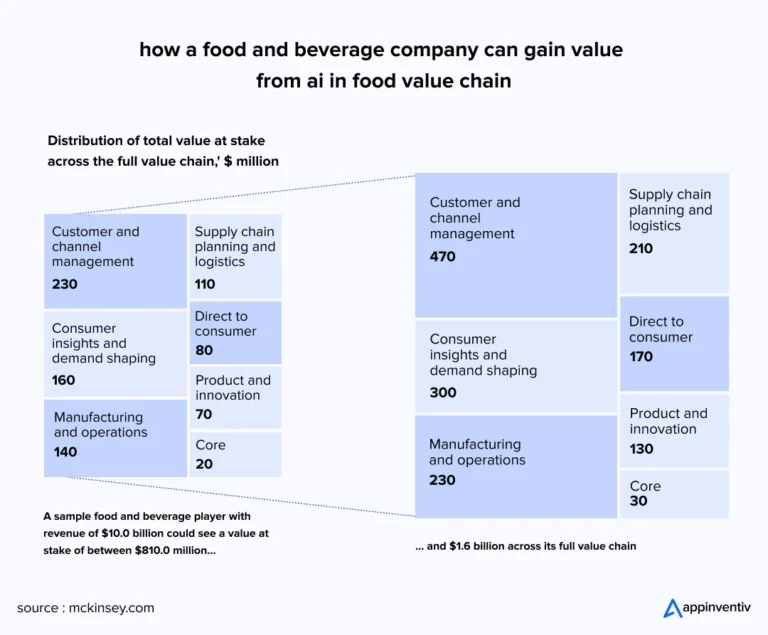
When it comes to customer engagement, BCG’s research reveals something fascinating: Generative AI in food industry is revolutionizing how leading restaurants communicate with customers, helping them eliminate bottlenecks and deliver highly personalized recommendations and offers. This technology has been proven to drive repeat visits and boost revenue by 6% to 10%.
Here’s where it gets really interesting, though. The AI in the food & beverages market was valued at $8.45 billion in 2023 and is anticipated to reach $84.75 billion by 2030, growing at a staggering CAGR of 39.1%. That’s 10x growth in seven years.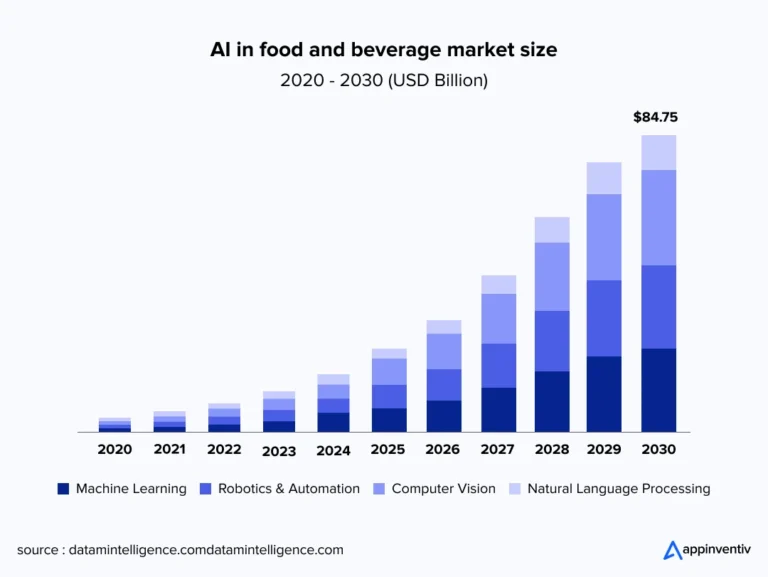
These numbers reflect the wider and broader use of AI in food and beverage industry, from automation and predictive analytics to customer relationships and supply chain management.
So, are you still observing the AI wave from the sidelines? The food industry’s next revolution has already begun, and those investing in AI-driven app development today will define tomorrow’s market leaders.
AI-enabled food delivery apps aren’t just about placing orders anymore. They’re creating intelligent ecosystems that predict, personalize, and optimize every interaction. Let us look into the major use cases of AI-powered food delivery app development below: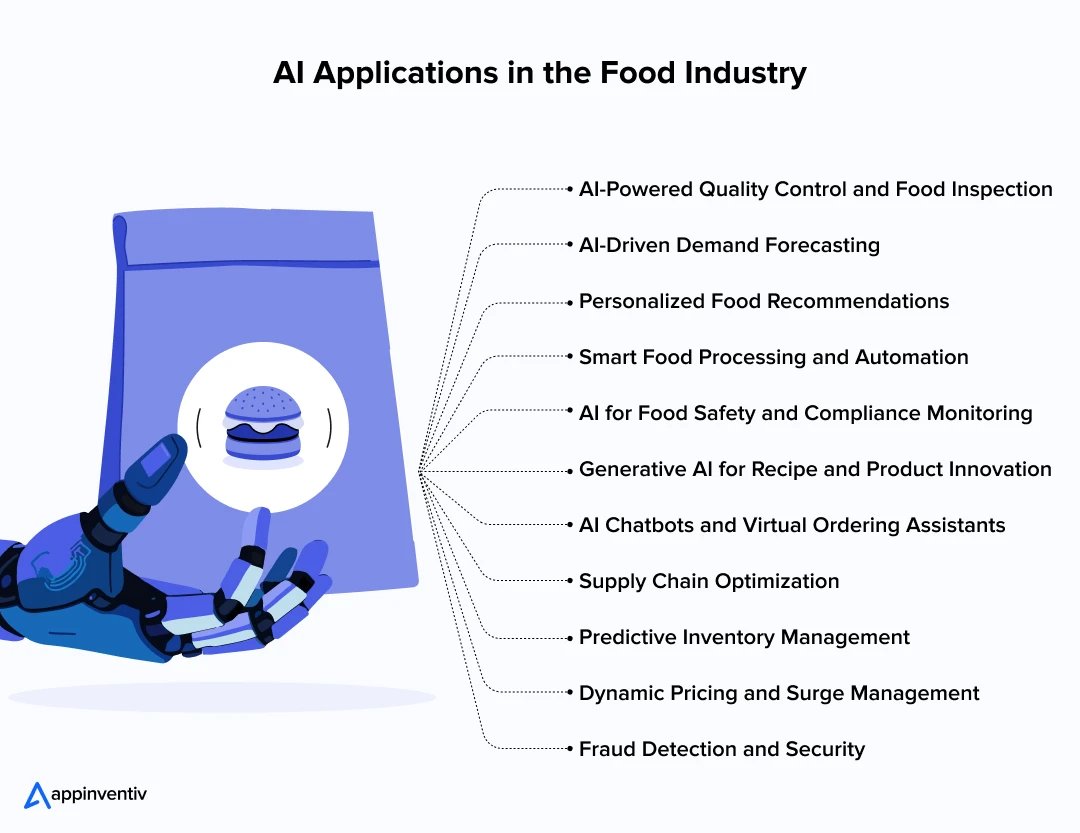
Ensuring food safety and consistency at scale is a constant challenge. Traditional human inspection can’t always catch every flaw, but AI can. AI ensures every meal meets your brand’s quality standards.
AI-powered food apps with vision control can analyze thousands of products per minute to detect imperfections, contamination, or irregular packaging. These AI models are built using computer vision and deep learning that can scan even microscopic differences in color, shape, or size.
AI Tech Stack in Action
These systems are built with computer vision libraries like OpenCV and deep learning frameworks such as TensorFlow or PyTorch. They can be trained to identify dozens of unique defects simultaneously, operating at speeds no human team could match.
Real World Example: DoorDash uses AI-driven computer vision to detect packaging damage and verify order accuracy before delivery. The system flags anomalies like missing items or spilled meals using image analysis, improving quality assurance and reducing customer support tickets.
Your Next Move
Predicting food demand accurately means the difference between profit and waste. AI predicts what customers will order before they do. AI-powered demand forecasting apps for food delivery analyze historical sales data, weather forecasts, local events, and online sentiment to forecast what customers will order next.
By using these insights, restaurants and food chains can better plan procurement, production, and delivery. How does AI make this possible? AI in food delivery apps uses machine learning algorithms to analyze multiple data streams simultaneously.
AI Tech Stack in Action
Python with TensorFlow or PyTorch handles predictive modeling, while Apache Kafka manages real-time data streaming. PostgreSQL stores your time-series data efficiently.
Real World Example: Uber Eats uses AI-powered predictive analytics to forecast demand surges across cities. Its models factor in weather, traffic, time of day, and local events to allocate delivery partners and balance kitchen load, improving on-time delivery rates and reducing idle fleet costs. The result? Reduced food waste, optimized production schedules, and improved product availability.
Your Next Move
AI makes every customer interaction personal. AI in food delivery apps transforms everything, from how users explore food choices to place orders and even track deliveries. What’s more? AI-powered recommendation engines study past orders, spending behavior, and dietary choices to predict what users want next.
By understanding patterns and preferences, food delivery apps can help serve tailored dishes that increase engagement and retention.
AI Tech Stack in Action
Python with scikit-learn for collaborative filtering, Apache Spark processing large-scale behavioral data, MongoDB storing detailed user profiles, Redis delivering split-second recommendations without lag.
Real World Example: McDonald’s uses AI-based decision technology through its Dynamic Yield platform to personalize drive-thru and digital menu boards. Depending on the weather, time of day, trending orders, and customer profiles, McDonald’s adjusts menu displays in real-time to suggest items most likely to appeal to each customer. This AI application in food service has led to increased average order values and improved customer retention.
Your Next Move
Manual food processing creates bottlenecks, inconsistencies, and safety risks that kill profitability. AI automation in food delivery apps eliminates these inefficiencies related to food production and packaging. From robotic sorting and slicing to automated quality checks, AI in food applications ensures precision, speed, and consistency in every process.
AI Tech Stack in Action
Industrial robots are controlled by reinforcement learning algorithms. Computer vision systems built with TensorFlow identify defects instantly. IoT sensors feed real-time data through Azure IoT Hub. Meanwhile, predictive models developed with Scikit-learn forecast equipment maintenance needs.
Real World Example: Domino’s uses AI-driven kitchen automation for dough preparation and ingredient dispensing. The system ensures consistent quality across stores while cutting prep time significantly.
Your Next Move
Food safety violations can destroy a brand overnight. One small incident can cost millions or sometimes lifetimes to improve brand image. AI-powered food apps monitor temperature, hygiene, and storage conditions in real time, ensuring compliance with food safety regulations.
AI Tech Stack in Action
IoT temperature sensors streaming data through AWS IoT Core. Machine learning models detecting anomalies using Python and scikit-learn. Blockchain technology ensures immutable traceability records via Hyperledger Fabric. Automated reporting dashboards built with Tableau.
Real World Example: Just Eat Takeaway uses AI and IoT data to monitor kitchen compliance and delivery conditions across partner restaurants. When contamination occurs, the system identifies affected products within seconds instead of days.
Your Next Move
Generative AI in food delivery apps is changing how new food items are conceptualized and tested. Instead of relying solely on chefs and R&D teams, food companies are using AI to create recipes that meet nutritional targets, flavor profiles, and regional trends.
By analyzing millions of ingredient combinations, these models predict how different ingredients will interact, cutting months off traditional recipe testing cycles and improving product-market fit.
AI Tech Stack in Action
Generative AI systems use ChatGPT-4 for enterprises and similar large language models for ideation, TensorFlow for data modeling, and Python APIs for nutritional and sensory simulations.
Real World Example: NotCo, a Chilean food tech company, uses its AI platform “Giuseppe” to create animal-free versions of popular foods. The AI analyzes thousands of plant ingredients, predicting combinations replicating the taste and texture of dairy and meat products. Giuseppe created NotMilk, a plant-based milk matching dairy milk’s taste, in months instead of the years traditional R&D requires. The product achieved a 70% repeat purchase rate, proving AI-generated recipes can succeed commercially while cutting development costs by 60%.
Your Next Move
Customer expectations for instant communication have redefined service in food delivery. AI chatbots in food delivery applications now act as 24/7 digital concierges that instantly answer queries, take orders, resolve complaints, and even recommend meals based on user preferences.
AI Tech Stack in Action
Dialogflow or Rasa frameworks providing NLP capabilities. Python with BERT or GPT models understanding context and intent, WebSocket technology enabling real-time communication and MongoDB storing conversation histories for continuous learning.
Real World Example: Domino’s “Dom” virtual assistant handles orders through voice, text, and social media platforms. Customers order pizza by simply saying “the usual” or describing what they want conversationally. Dom processes natural language, confirms orders, tracks delivery, and handles modifications; all without human intervention.
Your Next Move
Supply chain inefficiencies bleed money on every transaction in terms of overstocking, stockouts, and inefficient routes. AI-powered supply chain optimization track everything, from ingredient sourcing to last-mile delivery, to minimize waste, cut costs, and maintain reliability.
By combining real-time fleet data, predictive analytics, and smart routing, AI enables better route planning and inventory distribution. This leads to reduced delivery times, lower emissions, and optimized kitchen throughput.
AI Tech Stack in Action
Python with forecasting models such as Prophet or ARIMA helps predict demand patterns. Optimization algorithms powered by OR-Tools identify the most efficient delivery routes. Apache Kafka streams real-time supply chain data seamlessly, while cloud platforms like GCP provide the scalable processing power needed to handle it all.
Real World Example: Deliveroo uses AI-driven logistics to optimize order batching and rider dispatching. Its system factors in food prep times, distance, and rider availability. This AI capability ensures timely deliveries while reducing idle time and operational costs.
Your Next Move
Inventory shortages and overstocking cost serious money; too much creates waste, too little loses sales. AI-powered inventory management systems help food delivery partners maintain the perfect balance, ensuring every ingredient is available, fresh, and efficiently used.
By analyzing sales data, seasonality, and vendor timelines, AI models forecast ingredient demand and automate reordering. This minimizes spoilage while keeping kitchens ready for any surge in demand.
AI Tech Stack in Action
Python with LSTM neural networks analyzing time-series patterns. PostgreSQL stores historical inventory data, Apache Airflow orchestrates automated workflows, and visualization tools like Tableau provide actionable dashboards.
Real World Example: Grubhub uses AI-based predictive analytics to assist partner restaurants in inventory planning. The platform’s demand forecasts help optimize procurement and reduce wastage, improving margins across its partner network.
Your Next Move
Customer demand in food delivery fluctuates by the hour, location, and event. AI dynamic pricing applications for food delivery continuously analyze market signals to adjust delivery fees, menu prices, and discounts. These AI models balance the interests of customers, restaurants, and delivery partners in real time, improving efficiency across the ecosystem.
AI Tech Stack in Action
Python with reinforcement learning frameworks like Ray RLlib optimizes pricing strategies. Redis provides real-time price updates, Apache Kafka streams market condition data, and A/B testing frameworks measure pricing effectiveness.
Real World Example: Uber Eats utilizes sophisticated AI algorithms that dynamically adjust prices based on restaurant capacity, delivery partner availability, customer demand, and competitor pricing. During high-demand periods, strategic surge pricing balances supply and demand while maximizing revenue. The system also offers personalized discounts to price-sensitive customers at optimal times.
Your Next Move
Fraud costs the food delivery industry billions annually. How? Fake orders, stolen accounts, and payment scams; these all turn into lost revenues and spoilage. AI defends against these threats by spotting abnormal patterns in real time, protecting both the business and customers.
Machine learning algorithms monitor every transaction, identifying deviations from legitimate user behavior such as sudden location changes, high refund frequency, or card mismatches and block them before damage occurs.
AI Tech Stack in Action
Python with XGBoost or Random Forest algorithms detecting anomalies. Apache Kafka enables real-time fraud monitoring, Elasticsearch analyzes log patterns, and graph databases like Neo4j map fraud networks.
Real World Example: DoorDash implemented AI-powered fraud detection to analyze millions of transactions daily. The system identifies suspicious patterns, such as multiple failed payment attempts, unusual ordering behavior, and coordinated fake accounts, blocking fraudulent orders before processing. This protection directly improved bottom-line profitability.
Your Next Move
Also Read: How Autonomous Food Delivery Robots Work: A Deep Dive into AI, Sensors, and Navigation
When Americana Group needed to own its digital narrative instead of relying solely on aggregators, it turned to Appinventiv. Across their flagship brands: KFC, Domino’s, and Pizza Hut, we stepped in to build the modern digital platforms necessary to support future AI integration.
We developed a unified ecosystem that supports personalization, predictive analytics, and real-time customer engagement. Each solution was designed to ensure smooth AI adoption down the road, from data structuring to API readiness.
We redesigned Pizza Hut’s mobile experience to streamline ordering and make customer journeys more intuitive.
The Result?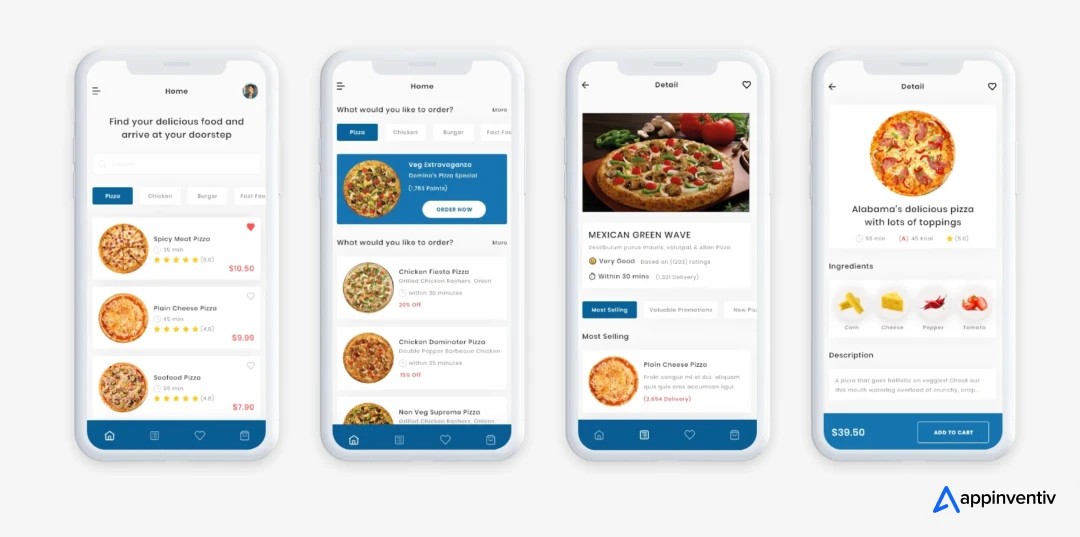
We supported KFC’s growth across multiple regions by engineering platforms that scale effortlessly and deliver consistent performance worldwide.
The Result?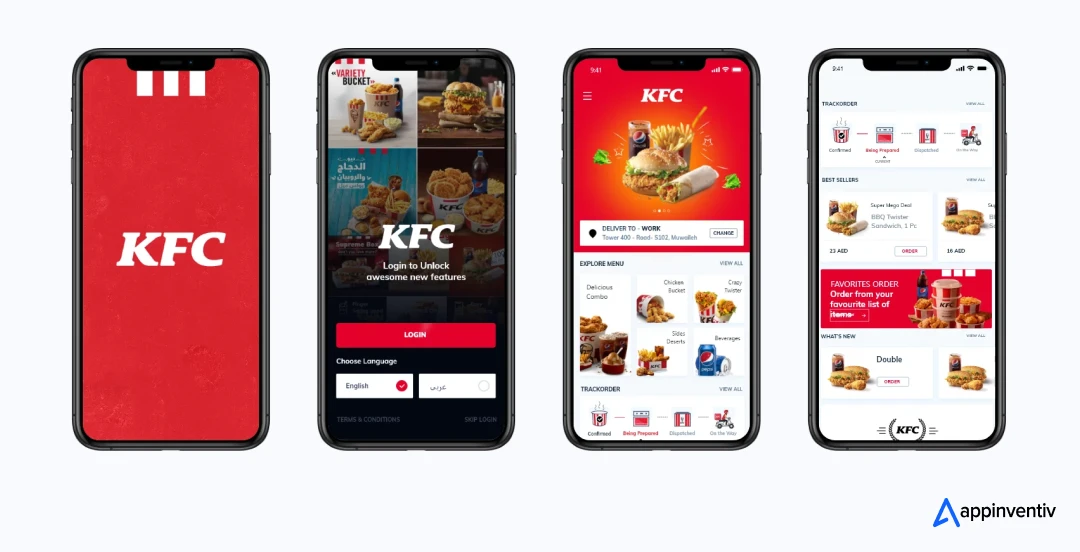
Domino’s
We reimagined Domino’s app experience by simplifying navigation and enhancing UI/UX flows, keeping customers engaged from first tap to final checkout.
The Result?
By tailoring systems, localizing features, optimizing performance and future-proofing architecture for AI integration, Americana Group went from dependency on third-party apps to controlling the customer journey and securing stronger brand equity in the digital age.
The transformation allowed the brand to own its data, control the customer journey, and strengthen brand equity, setting a solid foundation for intelligent automation and data-driven decision-making in the years ahead.
If you are still confused regarding the innumerable benefits of AI in food industry, have a look at a few of the most important ones listed below.
Implementing AI in the food service industry offers several benefits in terms of enhanced precision, efficiency, and workers’ safety. These advancements lead to cost savings, improved customer experiences, and sustainable practices. Want to know how? Here’s why enterprise leaders are prioritizing AI-powered development: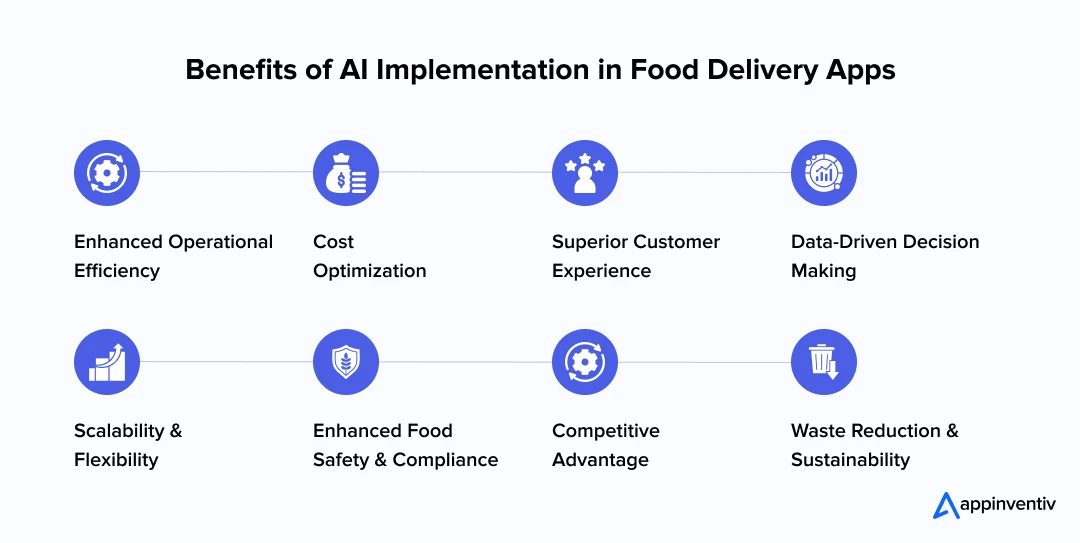
AI automation handles repetitive tasks from order processing to delivery allocation. This translates to:
Investing in AI-driven food delivery app development isn’t just about automation; it is also about cost savings:
AI-powered development enables hyper-personalized experiences that drive genuine loyalty:
Applications of AI in food delivery apps collect and analyze data on production, consumer preferences, and equipment performance. Integrating AI in food apps provides actionable insights across:
AI technology in the food industry gets programmed and reprogrammed easily for different jobs, giving you tons of flexibility. AI-powered platforms enable seamless scaling:
Food safety regulations are strict worldwide, and manual checks alone can no longer keep pace. AI in food applications ensures regulatory compliance through:
Early AI adopters gain substantial market advantages over those who are still thinking or delay in embracing AI for businesses:
AI integration in food applications supports long-term sustainability by minimizing waste and optimizing resources. From smarter inventory management to eco-friendly sourcing, AI ensures responsible operations.
Also Read: 10 Use Cases and Real Examples of How AI is Used in the Restaurant Industry
AI in food delivery apps isn’t here to make kitchens colder or take people out of the process. It’s here to make things work better: faster service, fewer errors, smarter decisions, and less waste. When used thoughtfully, it changes how a food business runs from the inside out. Here’s how to successfully weave AI into your food operations: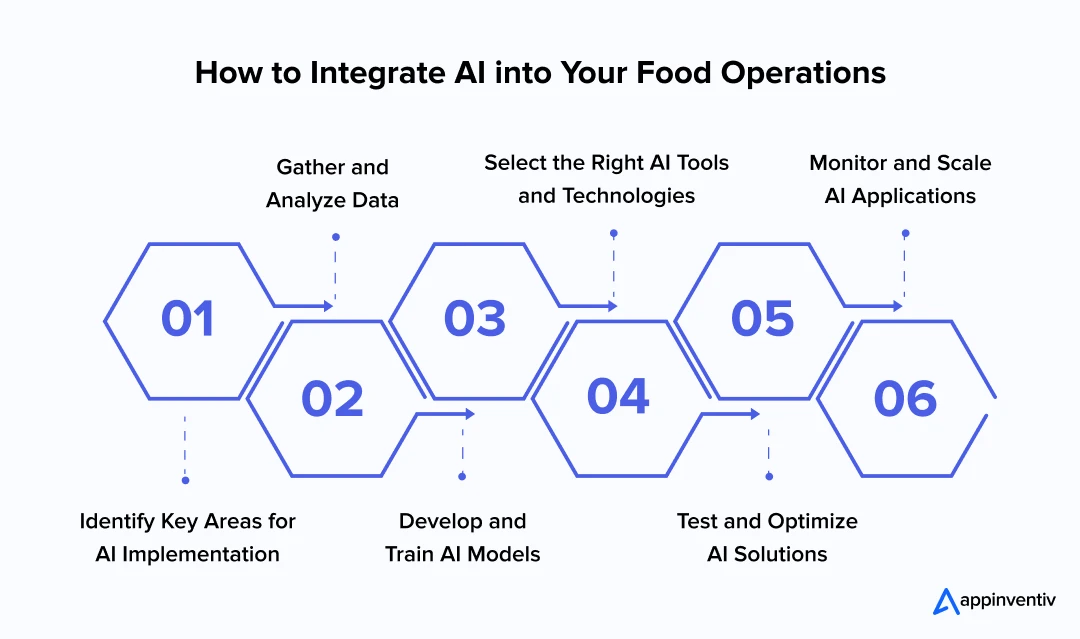
Start with the Right Problems
Before thinking about tools or algorithms, ask a simple question: Where are we losing time or money? That’s usually where AI can help most. Whether it’s food processing, customer service, inventory management, or production tweaks, figuring out where AI can add value is essential.
AI in food service industry operations, manufacturing and quality control centers offers substantial improvements, so prioritize based on your unique needs and targets.
Don’t try to automate everything on day one. Pick one process that slows you down, and build from there.
AI learns from data, but in food operations, that data tells human stories: what customers order, how long meals take, which ingredients run out too early.
Start collecting that information properly. Pull it from sales systems, stock logs, delivery apps, and even feedback forms. Then clean it up; remove duplicates, fill in gaps, make sure it’s consistent.
If your data is messy, your AI will be too. Clean, connected data is what separates good AI from random guesses.
Every food business is different. A cloud kitchen’s needs are not the same as a packaged-food brand’s. So when you build an AI powered food delivery app, pick the right AI tech stack. Think about what works for your setup and users.
You might need predictive analytics to plan supply runs or image recognition to spot quality issues. Maybe it’s an AI chatbot to handle repeat customer queries. The goal isn’t to have the fanciest tool; it’s to have the right one that quietly fixes the real problems.
Once you’ve got your data and chosen the right tools, start small. Partner with a food delivery app development company that understands both AI and the food business. Train your models on real data: your recipes, your timings, your order patterns.
A generic model won’t know that people in the US order differently from people in Dubai. That kind of insight only comes from your data. Custom-built AI learns faster and performs better because it understands your environment from the start.
Before rolling anything out fully, test it as if you’re the one using it. Does it make your team’s life easier? Are customers noticing faster service or better recommendations?
Whether it’s AI in food and beverage industry for customer engagement or AI in food manufacturing optimizing production, testing spots the improvement areas and ensures accuracy.
Run small pilots in one branch or process. Watch what happens. Fix what feels off. AI systems get smarter with every iteration but only if you take the time to listen and refine.
The AI in food delivery app development process isn’t something you launch and forget. It needs watching, just like your ovens or your delivery vans.
Keep checking if the system is still accurate, useful, and aligned with your goals.
Review the results, measure ROI, and stay open to tweaks. As your business expands, customer habits shift, or new tools emerge; your AI should evolve too.
From kitchen to customer, we make every step smarter, faster, and more profitable.
While artificial intelligence is driving remarkable transformation in the food industry, the road to implementation is not without barriers. Businesses that are wishing to leverage the maximum advantages of AI in food industry need to proactively address these hurdles:
When developing a food delivery app with AI, one of the most critical questions that keeps enterprises awake at night is, “How much does it cost to develop an AI-powered food delivery app?”
Honestly telling, there is no one-size-fits-all approach to quote the exact cost. The answer depends on multiple factors such as the number of features, platform choice, tech stack selection, team location, and project complexity. Here’s a detailed breakdown of on-demand AI food delivery app development cost based on different project complexities:
While the cost of food delivery app with AI seems substantial, there are multiple ways you can use to optimize this cost. Want to uncover these cost optimization strategies? Well, here is a table outlining some tried and tested techniques to reduce AI product development costs for food delivery:
The future of AI in food delivery app development isn’t jus
t promising; it’s already unfolding in real-time. Here’s what’s coming next based on current AI trends and emerging technologies: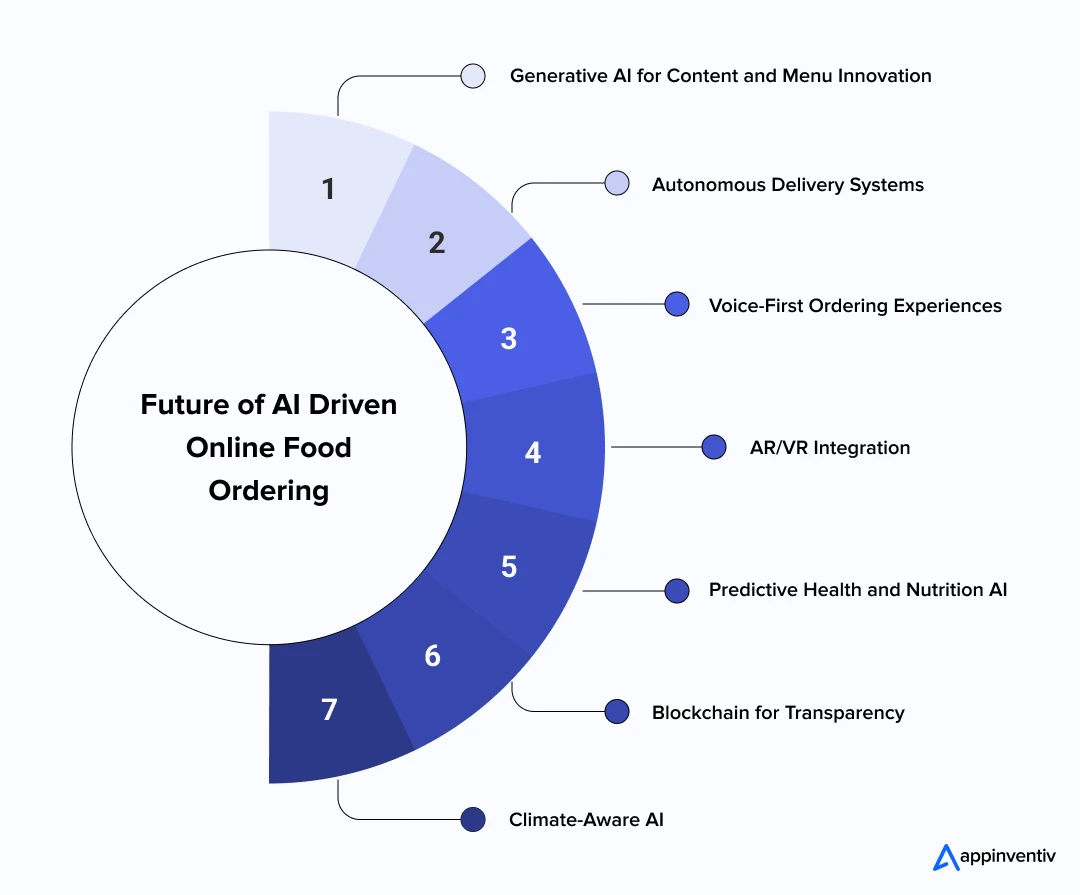
Generative AI in business will transform menu creation and marketing by providing automated, intelligent, and visually engaging content. Generative AI will revolutionize food delivery through:
Physical food delivery is transforming rapidly with on demand AI food delivery app development. For instance:
Voice technology is all the rage in the recent years. It is not only dominating eCommerce and entertainment industries but also widening its wings in the food sector. For instance:
Also Read: How to Build an AI Voice Agent? Process, Costs & Features
AR/VR adoption in food delivery is making waves and creating immersive experiences. This trend will change how customers explore food:
AI proactively supports healthier eating by analyzing customer health data and tailoring personalized meal recommendations. AI will proactively manage customer health:
Blockchain for business ensures trust and accountability across the food supply chain, making sourcing and quality verification fully transparent. Distributed ledger technology will enhance trust:
Implementation of Green AI in food business helps reduce environmental impact while optimizing delivery efficiency and sustainability. Environmental considerations will drive decisions:
Food businesses today face complex challenges: fast-changing customer needs, supply chain issues, fierce competition, and the constant pressure to improve efficiency. Overcoming these challenges and coming off with flying colors requires more than just adopting AI in business.
At a larger picture, food companies need to outsource AI development services from a trusted IT provider like Appinventiv. Our team of 1600+ tech experts can help build the right AI solutions, with the right approach and right tech stack tailored to your specific business needs.
We work closely with you to create responsible AI solutions that truly fit your business. Whether you need to forecast demand more accurately, improve food safety, reduce waste, or make your customer experiences more personal, we design and build AI tools that actually work for you. We even go a step beyond and provide post launch support to ensure your AI system remains functional in the long run.
We focus on building solutions that help you work faster, waste less, and grow your food business with confidence.
Our suite of AI services includes:
In our 10+ years of industry experience, we have delivered over 3000 fully+compliant projects, including 300+ AI-powered solutions. From emerging startups to established enterprises, we have empowered countless businesses to seize new opportunities and overcome operational challenges.
Our clients’ testimonials and recognitions like Consecutive Tech Fast 50 Awards in 2023 & 2024 by Deloitte and the Leader in AI Product Engineering & Digital Transformation by the Economic Times are the testament to our AI excellence.
So, what are you still waiting for? Contact our AI experts today and know how we can help expand your wings in the AI world.
Q. What challenges might businesses face when implementing AI in food delivery?
A. Here are the key challenges businesses face when implementing artificial intelligence in food industry:
To know how to overcome these challenges, please refer to the above blog.
Q. What are the benefits of integrating AI into food delivery apps?
A. AI in food delivery app development provides several advantages in terms of improving visibility, speed, and decision-making. Key impact of AI in food app development include:
Q. Can AI be used to reduce food waste in the industry?
A. Yes, AI plays a major role in reducing food waste. For instance, AI-driven demand forecasting helps prevent overproduction by accurately predicting consumer needs, while smart food processing ensures precise portioning and minimal product loss.
AI also enhances real-time inventory monitoring to flag items nearing expiration, allowing supply chain optimization systems to reroute excess stock to areas of higher demand, thereby reducing spoilage and improving sustainability.
Q. How can AI enhance a food delivery app?
A. AI enhances food delivery apps across multiple dimensions. For instance:
Q. Can I build on-demand delivery apps for multiple restaurants?
A. Yes, absolutely. Building multi-restaurant food delivery platforms is increasingly common. The architecture involves three main user interfaces:
You’ll need a robust admin panel managing all participants, handling disputes, and analyzing performance metrics.
Q. Which AI technologies are used in food delivery app development?
A. AI-powered food delivery app development requires carefully selecting your tech stack. Here’s the comprehensive technology architecture we recommend based on 10+ years of experience:
Frontend Development
Mobile Apps:
Web Platform:
Backend Development
API Layer:
Microservices:
AI/ML Technologies
Machine Learning Frameworks:
AI Services:
Computer Vision:
Natural Language Processing:
Database Layer
Relational:
NoSQL:
Data Warehousing:
Cloud Infrastructure
Cloud Providers:
DevOps Tools:
Real-Time Features
Payment Integration
Security & Compliance
Chirag Bhardwaj is a technology specialist with over 10 years of expertise in transformative fields like AI, ML, Blockchain, AR/VR, and the Metaverse. His deep knowledge in crafting scalable enterprise-grade solutions has positioned him as a pivotal leader at Appinventiv, where he directly drives innovation across these key verticals. Chirag’s hands-on experience in developing cutting-edge AI-driven solutions for diverse industries has made him a trusted advisor to C-suite executives, enabling businesses to align their digital transformation efforts with technological advancements and evolving market needs.
Why AI is Essential for Modern Sales Forecasting – Benefits, Use Cases, Examples
Key takeaways: Traditional sales forecasting can be off, slow, and hard to adjust when things change. AI uses multiple data sources and updates forecasts in real time. Retail, manufacturing, and fintech companies see cost savings and smarter decisions with AI. Scalable and customizable AI solutions ensure forecasts grow with your business needs. Sales forecasting is…
How to Integrate an AI Chatbot Into Your Application — A Business Perspective
Key takeaways: Be clear on the “why.” Before you think about platforms or models, decide what the chatbot should achieve — faster support, better sales conversion, or something else. Bring IT, CX, and compliance into the room early. Get the basics right. Pick tools that can grow with you. Plan how the bot will use…
11 Greatest Barriers to AI Adoption and How to Beat Them: Your Implementation Roadmap
Key takeaways: Align AI with Strategy: Define clear, business-aligned AI goals with measurable outcomes to escape “pilot purgatory,” as Microsoft achieved with $13B in AI revenue. Strengthen Data Infrastructure: Tackle data silos and quality issues using governance, integration tools, and cloud platforms, like Amazon’s AWS, driving 35% of sales. Invest in People and Culture: Overcome…
Digital product consulting, development, and engineering company.
B-25, Sector 58, Noida –
201301,
Delhi-NCR, India
79 Madison Ave,
Manhattan,
NY 10001, USA
96 Cleveland Street,
Stones Corner,
QLD 4120
3rd Floor, 86-90
Paul Street EC2A 4NE
London, UK
Meydan Grand Stand,
6th floor, Meydan road,
Nad AI Sheba, Dubai
Suite 3810, Bankers Hall
West,
888 – 3rd Street Sw,
Calgary Alberta
Appinventiv is the Registered Name of Appinventiv Technologies Pvt. Ltd., a mobile app development company situated in Noida, U.P. India at the street address – B- 25, Sector 58, Noida, U.P. 201301.
All the personal information that you submit on the website – (Name, Email, Phone and Project Details) will not be sold, shared or rented to others. Our sales team or the team of mobile app developers only use this information to send updates about our company and projects or contact you if requested or find it necessary. You may opt out of receiving our communication by dropping us an email on – info@appinventiv.com
1600+ transformation engineers delivered
3000+ game-changing products.
We chose Appinventiv to build our financial literacy and money management app from start to finish. From the first call, we were very impressed with Appinventiv’s professionalism, expertise, and commitment to delivering top-notch results.
It has been a pleasure working with Appinventiv. The team is not only extremely versatile and competent but also very professional, courteous, and responsive. We certainly plan to continue working with Appinventiv for an indefinite period.
We took a big leap of faith with Appinventiv who helped us translate our vision into reality with the perfectly comprehensive Edamama eCommerce solution. We are counting to get Edamama to launch on time and within budget, while rolling out the next phase of the platform with Appinventiv.
I just want to take a moment to thank the entire Appinventiv team for your incredible support. We truly appreciate everything you’ve done, and we’re excited to continue working together as we grow here at KODA
After researching numerous companies, we finally found Appinventiv, and it was the best decision we could have made. They successfully addressed the challenges with our existing app and provided solutions that exceeded our expectations.
We approached Appinventiv with a clear vision to build a robust and future-ready platform that could seamlessly integrate with the busy lifestyle of our customers while uplifting their overall experience and giving us a competitive edge.
Transformation
Engineers Delivered
Game-changing
Products
Connect with our consultation experts to get:
Insights specific to your business needs
Roadmap to overcome your challenges
Opportunities to scale your business in this niche.