
Welcome to the forefront of conversational AI as we explore the fascinating world of AI chatbots in our dedicated blog series. Discover the latest advancements, applications, and strategies that propel the evolution of chatbot technology. From enhancing customer interactions to streamlining business processes, these articles delve into the innovative ways artificial intelligence is shaping the landscape of automated conversational agents. Whether you’re a business owner, developer, or simply intrigued by the future of interactive technology, join us on this journey to unravel the transformative power and endless possibilities of AI chatbots.
How to Choose the Best AI Agent Development Company for Businesses
25+ Disruptive AI Agent Business Ideas You Should Launch in 2025
How to Hire an AI Developer: The Complete 2025 Guide (Without Losing $500K in the Process)
How to Build an AI App? Steps, Features, Costs, Trends
AI in Transportation – 10 Benefits and Use Cases for Modern Enterprises
How to Build an Intelligent AI Model: An Enterprise Guide
Unleashing the Potential of Artificial Intelligence in the Oil and Gas Industry – 10 Use Cases, Benefits, Examples
AI in Real Estate: 16 Powerful Applications with Real Examples
AI in the Automotive Industry Transforms the Future of Business: Benefits and Use Cases
A leading digital platform to offer engaging shopping experience to users
A mobile app to digitalise & expand KFC’s digital footprint
The MIT Innovation award-winning app with $52 million funding reshaping the employment landscape.
A transforming ERP solution for the world’s largest furniture retailer
A refined UX strategy for Domino’s to increase their conversion rate by 23%
A SaaS-based financial literacy and smart money management platform for kids
How Autonomous Food Delivery Robots Work: A Deep Dive into AI, Sensors, and Navigation
How Edge Computing Enhances IoT App Performance
AI Platforms-as-a-Service (AI PaaS): Simplifying the Path to Enterprise AI
How to develop an LLM model? A comprehensive guide for enterprises
How Much Does It Cost to Build a Healthcare App?
How Much Does It Cost to Build an AI Product?
Driving Egypt’s AI Leadership: How Appinventiv Supports the National AI Strategy
The Economic Times Names Appinventiv “The Leader in AI Product Engineering & Digital Transformation”
Appinventiv’s Vision for E-Government in the Middle East
How Much Does it Cost to Develop A Chatbot?
Enterprise Android App Development : Why you need it?
How to build an app like Exodus cryptocurrency wallet?
Enterprise IMs – The New Mantra To Business Productivity
How to Hire Developers for a Startup in 2025? A Guide for Non-tech Founders
Google releases new Dart 2.5 update with Flutter 1.9 version
AI is driving major transformation across industries, with real estate seeing one of the biggest shifts. Machine learning and AI in real estate have opened up a new era of business intelligence and operational efficiency, changing how industry leaders handle property transactions. With its strong ability to analyze market data, predict trends, and automate complex processes, AI is creating a shift that changes how executives buy, sell, and invest in properties across the entire real estate system.
Not surprisingly, the future of real estate depends heavily on AI solutions. The technology has made property management more efficient, streamlined, personalized, and customer-focused.
According to the Business Research Company, the AI in real estate market size will grow from $222.65 billion in 2024 to $975.24 billion in 2029, at a compound annual growth rate (CAGR) of 34.1%. This huge growth is driven by multiple strategic factors, including market analytics and forecasting capabilities, the rise of chatbots and virtual assistants for better customer service, and advanced machine learning in real estate algorithms that change property valuation and prediction methods.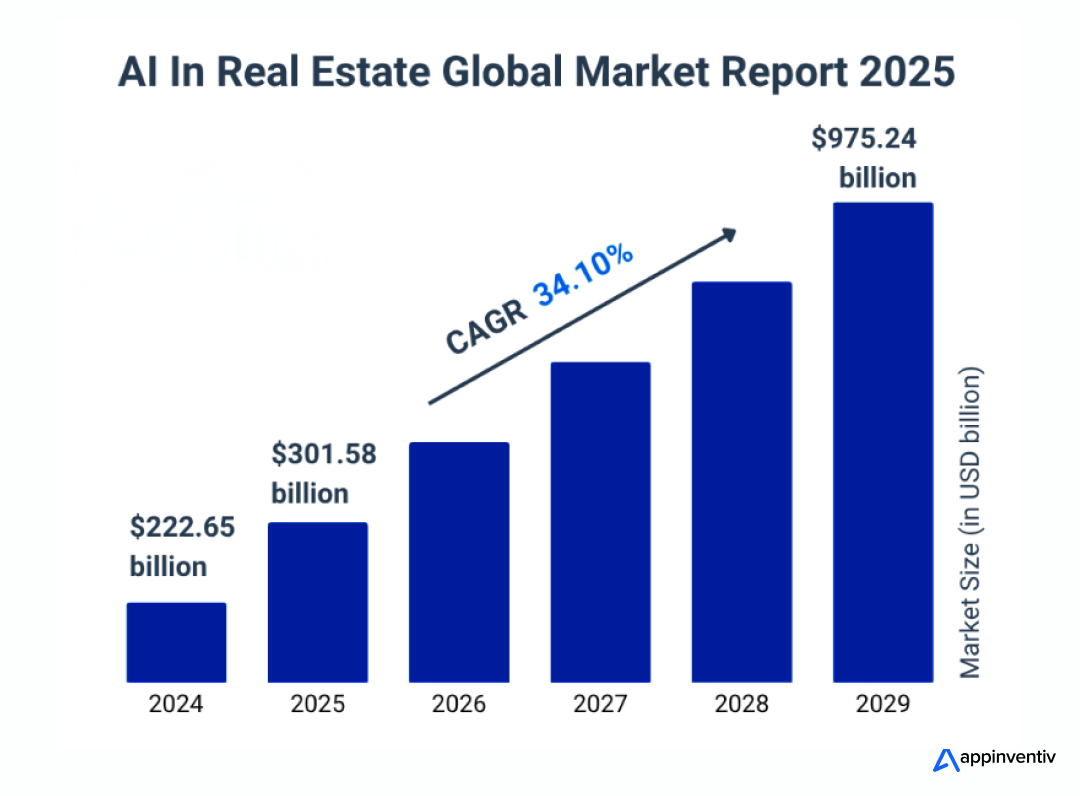
Generative AI applications in real estate are revolutionizing real estate operations by automating complex processes and delivering intelligent insights across all business functions. Using AI in real estate empowers executives to make faster, data-driven decisions while optimizing operational efficiency.
Core transformation areas:
Real estate leaders leveraging GenAI achieve reduced operational costs, faster transaction cycles, and superior stakeholder experiences while maintaining competitive market advantages. For anyone confused on will AI replace real estate agents, the answer is a clear no as it will work more in cohesion and not as a separate agent.
This blog examines how AI applications in real estate is shaping the industry, looking at 16 key applications, actual examples from the field, how to put these systems in place, and the obstacles companies face along with practical solutions.
Back in 2018, we saw the first big AI move in real estate when a company bought two Philadelphia properties worth $26 million. They used an algorithm that could spot buildings about to hit the market before anyone else knew. That was just the beginning – since then, these smart systems have taken off like crazy and pushed the whole industry into new territory.
By leveraging AI technology in real estate, professionals are finding innovative ways to transform the industry, which is having a real impact on business operations. Here are the most impressive AI use cases in real estate that are being put to work in real estate today.
AI in real estate takes care of the tedious task of cranking out listing descriptions on autopilot. Sure, there are plenty of ready-made software options that do a decent job with property listings, but you could also create your own custom solution or plug an AI model like ChatGPT into whatever system you’re already using.
You could build your own real estate AI tool and feed it a specific prompt about the property details to spit out a template – you’ll have a rough draft in seconds. Then you can reuse that template whenever you need to write up a new listing.
Key Technical Components:
How It Works:
The system analyzes successful listing patterns and property characteristics to generate descriptions that appeal to potential buyers while maintaining accuracy and relevance and is considered among the most important AI use cases in real estate.
Also Read: How ChatGPT for Enterprise Can Improve Business Operations
AR, VR, and metaverse tech in real estate are making it possible for potential buyers to get a real feel for properties without actually visiting them – it’s a perfect example of how AI in the real estate industry is making work better. Agents can now give buyers virtual walkthroughs that really capture what it’s like to be in the space.
This innovation in real estate artificial intelligence is particularly useful for properties that are still under construction or living in other countries. It also helps keep people at a safe distance and stops pre-scheduled showings from jamming up an agent’s schedule.
Key Technical Components:
How It Works:
The technology combines high-quality visual capture with AI-powered processing to build detailed 3D reconstructions. Users can then explore these virtual spaces through interactive extended reality (XR).
When people ask how AI in real estate works, property valuation often comes up first. AI-powered valuation platforms can automatically assess property values using complex algorithms that analyze market data, comparable sales, and property characteristics. Buyers and sellers get accurate pricing insights, making transactions more transparent and efficient. Properties are priced optimally, and negotiations become more data-driven when people have reliable valuation estimates.
It works by processing vast amounts of market information, letting stakeholders make informed decisions without relying solely on traditional appraisal methods. This cuts way down on valuation time and costs while helping people decide faster, which streamlines the entire buying and selling experience.
Key Components:
The system analyzes property features and generates accurate valuations that reflect current market conditions and neighborhood dynamics.
Getting profitable investments keeps any business alive, and real estate isn’t different. AI and ML in real estate helps investors identify lucrative opportunities from places like market data, financial reports, property metrics, and economic indicators. By using AI in real estate, investment teams can spend their time on the deals most likely to actually generate returns.
This makes profitable decisions happen faster. When you’re analyzing the right opportunities, real estate companies see better investment performance and more profitable portfolios overall.
Key Components:
The system analyzes investment patterns and assigns opportunity scores to help prioritize high-yield prospects.
AI in the real estate industry can make property management way less of a headache. Property management systems track rental listings, tenant applications, lease documents, maintenance requests, and other essential administrative tasks. These tools provide real estate professionals with valuable data about tenant preferences, recurring maintenance problems, neighborhood pricing trends, and seasonal rental patterns.
Additionally, real estate artificial intelligence scans property paperwork for errors such as missing signatures or incomplete fields, ensuring accuracy and regulatory compliance. These capabilities improve operational efficiency and support better decision-making for property managers.
Key Components:
The system processes property data to optimize operations, track maintenance requests, and analyze tenant behavior for better portfolio management.
Also Read: Cost to Build a Property Management Software
As generative AI-created images and content become more common in the amalgamation of AI and real estate, MLS providers struggle to catch fake photos and misleading descriptions. When listing information or pictures aren’t accurate, both MLS administrators and brokers can face serious penalties.
That’s where AI in the real estate industry steps in to help. Computer vision and machine learning can spot when listings have been tampered with and catch potential Fair Housing Act violations, helping realtors keep their listings accurate and legal. In addition, AI real estate agents can now spot discrepancies and potential violations in listings or contracts, safeguarding both agents and buyers from costly errors.
Key Components:
The system analyzes property content to ensure regulatory compliance and authenticity across listings and documentation.
Must Read: Financial Fraud Detection Using Machine Learning
Many property search apps have detailed filters that let investors choose homes based on price, design, square footage, and location. But finding the right properties can still be tough because of all the irrelevant filter options getting in the way.
Even if these apps don’t prove true to investors’ expectations, AI for commercial real estate can effectively address this issue. With AI technology in real estate, recommendation systems can quickly narrow down property searches based on individual preferences, providing personalized recommendations to potential investors.
Trulia can be a great example of a property search application as one among the many AI use cases in real estate that leverages AI-driven personalization to deliver tailored property recommendations.
Key Components:
This combined system of AI and real estate learns from user interactions and property characteristics to suggest relevant listings that match buyer preferences and past behavior.
Manual property searches dominate real estate processes, creating countless opportunities for mismatched buyer-property pairings. AI in real estate analyzes vast amounts of buyer preferences to identify ideal properties across multiple criteria, such as location preferences, budget constraints, and lifestyle requirements. During property matching processes, understanding these personalized preferences proves crucial for successful transactions and ensuring satisfied clients.
Automated recommendations via artificial intelligence for real estate accelerate the search process while reducing search fatigue, leading to more targeted property viewings. When real estate professionals leverage AI for personalized matching tasks, they gain time to concentrate on strategic priorities and deliver superior client service, fostering greater efficiency and satisfaction throughout the industry.
AI for commercial real estate allows agents to dedicate more time to client relationship building and business development rather than becoming overwhelmed by repetitive property screening work. This provides a competitive advantage in an ever-changing marketplace.
Key Components:
The use case of artificial intelligence for real estate parses buyer profiles, extracts relevant preferences, and suggests optimal properties by comparing requirements against established buyer behavior patterns and property databases.
What is the right price to purchase a property that can give a good return tomorrow? It is a question that lingers in everyone’s mind when investing in a property. Conducting a property analysis and future validation is an intimidating task, as determining the right price depends on several factors. These factors include, but are not limited to, crime rates, transportation options, noise disturbance, schools, hospitals, lighting sources, purchasing trends, future development in the area, and others.
A common realtor can’t evaluate all the small details and visualize the right price. It is where AI real estate agent comes in handy. The application of artificial intelligence in real estate can help businesses provide correct information about a particular property. For instance, AI can evaluate the seasonal light disparities and verify realtors’ adverts for ‘sunny’ homes. It also evaluates property features, such as home décor, age, size, and number of rooms, to determine a viable price range.
Key Components:
The system processes diverse data inputs to create accurate property valuations based on location factors, market conditions, and physical property characteristics.
The limitless capabilities of AI in customer experience and support are evident to all; it has already revolutionized businesses across various industries. Recognizing AI’s expanding potential in client engagement, real estate companies now embrace AI-powered solutions. Conversational AI in real estate is transforming customer service delivery and promotional efficiency through marketing automation and virtual assistants.
Conversational AI in real estate is empowering agents to connect with clients instantly, boosting engagement, and driving satisfaction with tailored, real-time responses.
Key Components:
The system of AI and real estate processes customer interactions and accesses real-time client information to provide helpful, accurate marketing materials about listings, market data, and personalized services.
Document analysis in real estate presents a complex and time-intensive challenge due to inconsistent templates, which hinder the extraction and organization of data from varied formats. However, artificial intelligence in real estate streamlines this process by efficiently extracting relevant information from diverse documents, including appraisals, lease agreements, and loan papers, completing in minutes what would require days of manual work.
Moreover, through optical character recognition (OCR) technology, AI real estate agent can accurately organize even handwritten or poorly scanned documents. This capability not only demonstrates how AI can be effectively utilized in real estate but also ensures that processed data integrates seamlessly into existing workflows, making it readily accessible to all company members through simple searches.
Key Components:
Through optical character recognition technology, AI can accurately organize even handwritten documents, ensuring processed data integrates seamlessly into workflows and remains accessible to all company members through simple searches.
AI algorithms drive predictive analytics that analyze vast amounts of historical and current market data, providing real estate professionals with forward-looking insights. The technology evaluates factors such as equipment usage patterns, environmental conditions, and maintenance records, enabling property managers and other stakeholders to make more informed decisions.
AI for commercial real estate reduces costs by revealing potential equipment failures and uncovering fresh maintenance opportunities. Real estate firms leverage predictive maintenance to maximize asset performance and maintain their competitive edge by refining their maintenance strategies, allocating resources more effectively, and addressing issues before competitors realize what’s happening.
Key Components:
The system processes historical maintenance data and sensor readings to predict future equipment failures and maintenance needs across different property systems.
Asset managers and real estate investors can now allocate capital strategically across various properties and markets through AI-powered portfolio optimization tools. These AI systems analyze historical performance data, market patterns, risk assessments, and investor preferences to determine optimal portfolio composition.
AI algorithms identify diversification opportunities, asset allocation adjustments, and risk mitigation strategies that align portfolios with investment objectives and current market conditions.
AI in the real estate industry processes real-time data, enabling rapid portfolio strategy adjustments when markets fluctuate or new trends develop. When businesses implement AI in commercial real estate for portfolio management, they can make superior investment decisions, enhance returns, and manage risks more effectively. This maintains portfolio growth and resilience over time in volatile real estate markets, helping agents remain competitive and adaptable with their strategies.
Key Components:
The system analyzes market feedback and optimizes investment portfolios by balancing multiple objectives across different real estate asset classes.
AI-powered lease management systems streamline the creation, negotiation, and oversight of lease agreements, reducing the time and costs traditionally consumed by these processes. These systems utilize machine learning to review lease terms, legal requirements, and industry standards, ensuring compliance and minimizing dispute risks.
AI in commercial real estate automates routine tasks such as rent collection, lease renewals, and maintenance request processing, improving operational flow for property managers and landlords. By maintaining all lease data and documentation in secure digital systems, AI enhances accessibility, updates, and auditing capabilities, improving transparency and supporting regulatory compliance.
Key Components:
The system processes lease documents, ensures regulatory compliance, and automates routine management tasks like renewals, payments, and maintenance scheduling.
Automated property valuation systems utilize AI algorithms to rapidly and accurately determine real estate property values. These systems analyze historical sales data, property characteristics, location factors, and current market conditions to generate precise valuations. By eliminating human bias, AI in commercial real estate delivers more accurate and consistent property appraisals, providing real estate professionals with reliable information for buying, selling, or refinancing decisions.
These models also support portfolio management by providing current property values, informing strategic asset allocation decisions, and guiding investment planning. When organizations integrate smart technology for real estate into their property valuation processes, they optimize resource utilization, minimize valuation inconsistencies, and enhance overall portfolio performance.
Key Components:
The system analyzes sales data, property features, and visual imagery to generate accurate market valuations and trend predictions.
AI transforms risk assessment and analysis in real estate by employing algorithms to evaluate potential investments using comprehensive data sources. It examines market volatility, economic indicators, property condition reports, and historical performance data to predict investment reliability and assess potential risks.
AI in commercial real estate equips investors and property managers with essential information for making informed decisions, reducing investment losses, and maintaining smoother operations. It also identifies risk patterns to optimize portfolio allocation and enhance investment performance, which contributes to improved long-term real estate investment outcomes.
Key Components:
The system analyzes investment data, market history, and economic patterns to generate risk scores and identify potential investment hazards.
Real estate companies have been leveraging various technologies, including robotics, the Internet of Things (IoT), artificial intelligence, machine learning, and others, to catalyze a paradigm shift in the industry. These companies use AI in real estate development to revolutionize the buying, selling, and investing process in property.
Here are the five real examples of real estate AI companies that use advanced technologies like IoT, AI, and machine learning in real estate to attract more investors.
Ility, a SaaS-based white-label real estate platform developed by Appinventiv, integrates advanced technologies such as AI, IoT, and cloud computing. This platform for AI and real estate enables commercial property owners to manage their multi-property portfolios effectively.
Through smart technology for real estate, Ility delivers real-time insights into property conditions and operational efficiencies, improving maintenance scheduling and cost control. Cloud integration ensures smooth scalability and secure data handling, enabling landlords to streamline their operations and capitalize on growth opportunities. Through innovative AI in real estate development, such as DocuSign, Tidio chat assistant, and Sendbird chat, Ility can garner interest from multiple investors for funding.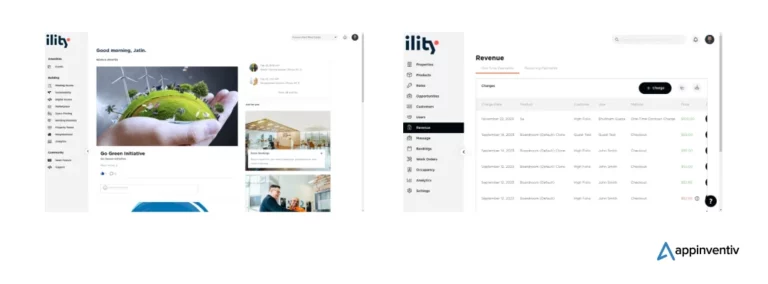
Through our efforts, we accomplished:
Keyway falls among the perfect examples of AI in real estate. It is an AI-powered real estate investment manager that leverages AI, data science, and other technologies to make informed decisions and achieve better results. The company partners with multifamily property owners and private practice doctors, veterinarians, dentists, and other medical professionals in the healthcare sector to offer them service models, such as rent-to-own and transition-out.
Zillow, a trusted name in real estate AI companies, leverages AI to analyze digital photos and other relevant metrics, generating free property value estimates (Zestimates). This technology harnesses the power of a neural network, which is trained on vast datasets comprising millions of photos and corresponding home values.
The neural network “reads” the photos in new property listings to extract relevant information. The AI-driven estimates project property value with a national median error rate of 2.4%, contributing to highly accurate predictions.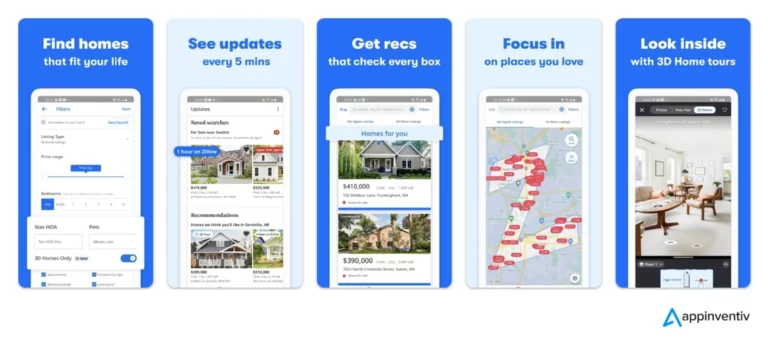
Trulia is a prominent real estate marketplace that utilizes AI to provide personalized property recommendations and enhance the user experience. By analyzing user behavior, search history, and preferences, this AI-powered platform offers personalized property suggestions that align with individual preferences and interests.
Know: What is the Cost of Real Estate App Development Like Zillow or Trulia?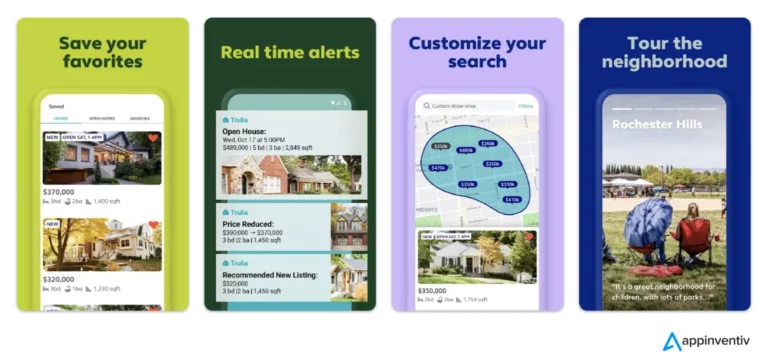
Redfin is a technology-powered real estate broker, lender, instant home-buyer (iBuyer), title insurer, and renovations company that uses AI to provide automated property valuations. They combine AI-driven data analysis with human expertise to offer accurate valuations to realtors.
Entera, a leading example of AI in business, operates in the real estate industry and offers a residential real estate investing platform that leverages AI to provide automated processes and intelligent analytics for discovering, purchasing, and managing single-family homes. The company operates across the US market, and its platform handles over 1,000 transactions per month.
Artificial Intelligence is expected to revolutionize the future of real estate technology by enhancing efficiency, providing deeper insights, and personalizing experiences. Here’s how AI use in real estate can be integrated across various real estate operations:
Automated valuation models (AVMs) analyze property sales, historical trends, and economic indicators.
Machine learning algorithms assess changes in demographics, economics, and interest rates.
AI for real estate investment leverages data analysis tools to evaluate property performance metrics and historical data, providing accurate ROI forecasts.
Recommendation engines and chatbots enhance the property search experience.
AR technologies pair with AI to create immersive virtual property tours.
Intelligent management systems optimize building operations to reduce energy usage and enhance maintenance.
Natural language processing (NLP) automates the creation and management of legal documents.
AI-driven marketing tools analyze customer data to enhance engagement and lead conversion.
Project management software uses AI to plan and manage construction effectively.
Pattern recognition algorithms scrutinize transaction patterns to identify potential fraud.
Predictive analytics enable proactive maintenance and facility management.
Artificial intelligence is transforming the real estate industry by reshaping how properties are bought, sold, and managed. From optimizing pricing strategies for property owners to enhancing tenant experiences and boosting agent productivity, AI enables faster decisions, better deals, and more personalized interactions.
At the same time, successful adoption requires careful consideration of challenges such as costs, data reliability, and privacy concerns. The table below outlines the key benefits, drawbacks, and potential solutions across different stakeholders in real estate.
According to McKinsey, Generative AI applications in real estate is set to shake up the real estate industry in a big way by making processes more efficient, personalizing how customers are served, and opening up fresh ways to make money. As this technology keeps improving, weaving it into different real estate processes signals a major change in how properties get marketed, managed, and developed, ultimately affecting the overall future of real estate technology..
Here are some of the potential impacts of Generative AI in real estate market that businesses can expect:
As generative AI keeps getting better, the benefits of AI in real estate will likely see these technologies become even more embedded in everyday work, delivering sharper analytics, more tailored client interactions, and creative fixes for old problems. This integration of artificial intelligence in real estate doesn’t just promise to make operations run better – it’s also set to completely change the customer experience and create new ways for businesses to make money in the industry.
Agentic AI represents the next evolution in real estate automation combined with artificial intelligence and real estate, going beyond simple task completion to autonomous decision-making and workflow management. Unlike traditional AI that responds to prompts, agentic AI in real estate operates independently to complete complex, multi-step processes without constant human intervention.
These intelligent agents are revolutionizing several key areas. In property management, they’re autonomously scheduling maintenance, coordinating with vendors, and managing tenant communications based on predefined parameters while learning from past interactions. Investment analysis has become completely automated as these systems independently research market conditions, compile comparative analyses, and even initiate preliminary negotiations on behalf of investors.
Real estate firms implementing agentic AI for realtors are discovering that these systems fundamentally reshape how professionals allocate their time and resources. Rather than managing routine tasks, agents can focus on high-value relationship building and strategic decision-making while intelligent systems handle the operational complexity behind the scenes.
The impact goes deeper than efficiency gains. These autonomous agents are creating entirely new service models where:
This shift represents a paradigm change from AI as a tool to AI as an autonomous workforce partner in real estate operations.
Successfully navigating the challenges and capitalizing on the opportunities presented by AI and machine learning in real estate investment demands a strategic approach in the adoption of AI for realtors. Let’s examine some of the implementation challenges of AI in real estate and solutions to address them.
Real estate AI implementation requires adherence to strict data privacy rules and regulations such as GDPR (General Data Protection Regulation), CCPA (California Consumer Privacy Act), PIPEDA (Personal Information Protection and Electronic Documents Act), and Fair Housing Act compliance, which vary between jurisdictions, thereby increasing implementation complexity and risk.
Solution: Close collaboration with the hired technology partner and legal experts is essential to guarantee that systems powered by AI for real estate agents comply with legal requirements and effectively solve these challenges. Strong data governance standards boost transparency and trust in AI-powered real estate operations while keeping user information safe. These proactive measures uphold ethical standards and address compliance issues, creating a positive space for AI innovation in real estate.
High upfront expenses and ongoing maintenance requirements across AI real estate solutions create significant barriers to adoption and sustainable deployment. When organizations face substantial technology investments, from infrastructure upgrades to software licensing, AI implementation struggles to deliver immediate ROI and cost justification essential for strategic decision-making.
Solution: To manage implementation costs, phased deployment and scalable pricing procedures must be implemented. Furthermore, the optimization of resource allocation made possible by investing in cloud-based solutions for AI for real estate agents allows organizations to scale more affordably and reliably. These steps enhance the overall feasibility and accessibility of AI-driven insights in real estate operations while streamlining cost management processes.
Due to the sensitivity of financial information and personal data, ensuring data accuracy and protecting against cyber threats in real estate AI systems can be challenging and time-consuming. Poor data quality can lead to inaccurate AI predictions and flawed decision-making, while security breaches expose sensitive client information and financial records to malicious actors.
Solution: Companies should prioritize developing robust data validation protocols and comprehensive security frameworks to minimize these challenges. Utilizing encryption-driven platforms accelerates the protection process and facilitates AI in real estate operations by enabling improved data integrity and privacy compliance across various systems.
The adoption and optimization of artificial intelligence in real estate are constrained by algorithmic bias and the absence of human intuitive judgment that can recognize subtle market nuances, cultural preferences, and interpersonal dynamics critical to successful real estate transactions.
Solution: Companies should invest in comprehensive bias detection systems and diverse training datasets to ensure their models for AI and machine learning in real estate investment reflect varied perspectives on AI for real estate agents – this represents the key to addressing this challenge. Establishing a robust framework of human oversight capable of handling the evolving demands of real estate can also occur through partnerships with behavioral scientists to develop specialized monitoring protocols and validation programs. These programs address algorithmic limitations while fostering inclusive decision-making and providing companies with a competitive advantage in AI-powered real estate operations.
AI systems in real estate operations may struggle with complex decision-making scenarios, relationship management nuances, or ethical considerations that require human judgment, potentially leading to over-reliance on automation and diminished personal service when technology capabilities exceed appropriate application boundaries.
Solution: Implement hybrid workflow protocols and collaborative approaches that combine AI for real estate agents with human expertise across different operational perspectives. Regular assessment of task allocation between humans and machines and incorporating real-time performance indicators help maintain service quality during complex interactions while establishing escalation mechanisms for human expert intervention when AI confidence levels drop.
AI in real estate systems may inadvertently perpetuate historical biases in lending decisions, property valuations, or tenant screening processes, potentially violating fair housing laws and creating discriminatory practices against protected demographic groups.
Solution: Implement comprehensive bias detection frameworks and fairness audits throughout the AI development lifecycle. Regular algorithmic impact assessments, diverse training datasets, and explainable AI techniques ensure transparent decision-making while establishing clear accountability measures and continuous monitoring for discriminatory patterns in AI-driven real estate processes.
Real estate AI systems operating alongside existing property management platforms must navigate varying database structures, API limitations, data format inconsistencies, and outdated infrastructure standards, creating complex integration matrices that increase operational risk and implementation costs.
Solution: Develop compatibility-focused AI systems with built-in middleware solutions that automatically adapt to existing platforms. Partnership with systems integration providers and implementation of modular API frameworks enable artificial intelligence in real estate to maintain seamless connectivity while scaling across multiple legacy environments efficiently.
The future of artificial intelligence in real estate looks like it will bring major changes and benefits of AI in real estate that will change industry dynamics completely. With AI involved, agents, realtors, property managers, and everyone else can expect more accurate property valuations, predictive analytics that predict market trends, and better personalized interactions through AI chatbots and virtual assistants.
As AI use in real estate deepens, it’s not just changing industry standards – it’s creating innovation and sustainable growth, making it a necessary technology for companies that want to redesign property management and use digital progress.
Adding AI real estate solutions can make operations smoother and improve client experiences. A structured approach makes sure the integration works well, using data-driven insights for things like valuation and lead generation.
Below is a concise roadmap for AI adoption, aligning with business goals and compliance.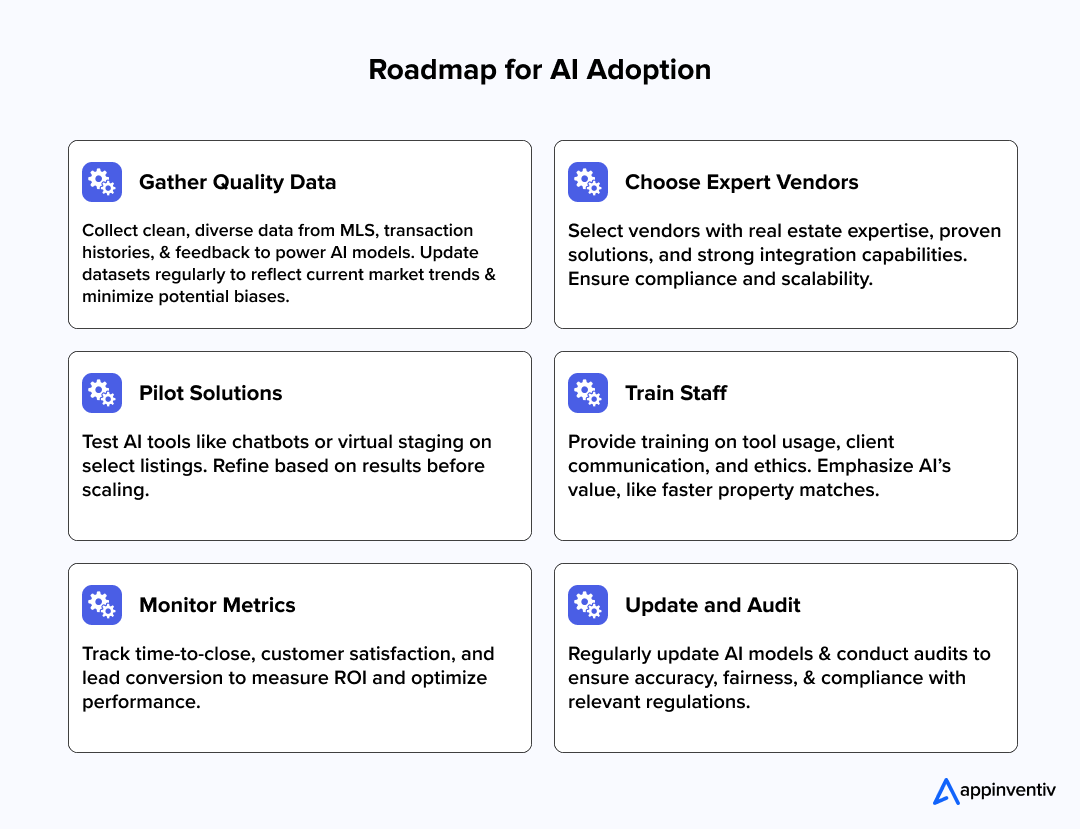
Navigating the complexities of AI adoption, from data quality challenges to seamless integration, requires a partner with proven expertise in both artificial intelligence and real estate. At Appinventiv, a real estate app development company, offering AI development services, we don’t just build tools; we architect strategic solutions that directly address the implementation hurdles facing today’s real estate leaders.
We solve your biggest AI challenges:
Key strategic advantages include:
Your competitive advantage lies not in adopting AI eventually, but in implementing it strategically today.
Partner with Appinventiv to harness the transformative power of AI, unlock new opportunities, and stay ahead in the ever-evolving real estate landscape with innovation that sets you apart.
Q. What are the benefits of AI for real estate agents?
A. AI transforms real estate operations through multiple key advantages:
Overall, AI enhances accuracy, client satisfaction, and competitive positioning in today’s dynamic real estate market.
Q. How is AI transforming the real estate industry?
A. AI is revolutionizing real estate through predictive analytics for property valuation, automated lead qualification, and personalized customer experiences. Machine learning algorithms analyze market trends, optimize pricing strategies, and identify investment opportunities faster than traditional methods. Virtual assistants handle initial client interactions, while computer vision automates property inspections and damage assessments. For C-suite leaders, AI delivers measurable ROI through reduced operational costs, accelerated deal cycles, and data-driven decision making that enhances portfolio performance and competitive positioning.
Q. How can Appinventiv implement generative AI in real estate market?
A. Appinventiv can implement generative AI in real estate market through custom chatbot development for 24/7 customer support, automated property description generation, virtual staging solutions, and personalized marketing content creation. Their expertise includes building AI-powered lead generation systems, document automation tools, and predictive analytics platforms. By leveraging machine learning algorithms and natural language processing, Appinventiv develops scalable solutions that streamline property operations, enhance client experiences, and optimize business processes for real estate companies.
Q: What are the best AI tools for real estate agents?
A. The best AI tools for real estate agents include Zillow’s Zestimate for automated property valuations, ChatGPT for listing descriptions and client communications, virtual staging platforms like Virtual Staging Solutions, CRM systems with AI lead scoring, and chatbots for 24/7 customer support. Additionally, predictive analytics tools help forecast market trends, while AR/VR platforms create immersive property tours that enhance buyer engagement and accelerate sales processes.
Q. How to use AI in real estate investing?
A. AI transforms real estate investing through automated market analysis, identifying undervalued properties using predictive algorithms that analyze comparable sales, neighborhood trends, and economic indicators. Machine learning models forecast rental yields, occupancy rates, and property appreciation potential. AI-powered due diligence accelerates deal evaluation by processing financial documents, legal records, and market data instantly. Portfolio optimization algorithms balance risk-return ratios across multiple assets. Implement AI tools for automated valuation models (AVMs), sentiment analysis of market conditions, and predictive maintenance scheduling to maximize returns while minimizing operational overhead.
Q. What is the future of AI in commercial real estate?
A. AI will reshape commercial real estate through autonomous building management systems, predictive maintenance reducing operational costs by 30-40%, and dynamic pricing models optimizing lease rates in real-time. Expect AI-driven tenant matching platforms, automated property underwriting, and blockchain-integrated smart contracts streamlining transactions. Advanced analytics will enable predictive space utilization, ESG compliance monitoring, and portfolio risk management.
Q. Are AI tools in real estate accessible for small businesses?
A. AI is fundamentally transforming the real estate market through innovative solutions that enhance every aspect of property transactions. This technological revolution impacts multiple areas of the industry:
Chirag Bhardwaj is a technology specialist with over 10 years of expertise in transformative fields like AI, ML, Blockchain, AR/VR, and the Metaverse. His deep knowledge in crafting scalable enterprise-grade solutions has positioned him as a pivotal leader at Appinventiv, where he directly drives innovation across these key verticals. Chirag’s hands-on experience in developing cutting-edge AI-driven solutions for diverse industries has made him a trusted advisor to C-suite executives, enabling businesses to align their digital transformation efforts with technological advancements and evolving market needs.
How Autonomous Food Delivery Robots Work: A Deep Dive into AI, Sensors, and Navigation
Key takeaways: Autonomous food delivery robots reduce last-mile costs and improve delivery speed. AI-driven perception, mapping, and re-routing make deliveries reliable and safe. Enterprises can integrate robots with ordering and logistics platforms for scale. Data from robot fleets provides insights for smarter operations and market expansion. Deployments align with sustainability goals through electric, energy-efficient fleets.…
AI Platforms-as-a-Service (AI PaaS): Simplifying the Path to Enterprise AI
Key takeaways: With the introduction of AI into daily processes, organizations are turning to adaptive and data-driven approaches to business, which improve efficiency and innovation. Using the AI Platform-as-a-Service (PaaS), businesses can develop scalable AI applications in a short time, simplifying their work and minimizing infrastructure complexities. AI platforms that offer pre-developed models and user-friendly…
How to Build an AI Voice Agent? Process, Costs & Features
Key takeaways: Best AI voice agents are shaking up how businesses operate by providing help around the clock, boosting customer experiences, and automating operations. The cost to develop an AI voice agent ranges between $40,000 and $400,000 or more, depending on the project complexity. Key tech pieces include ASR, NLU, LLMs, and TTS; each one…
B-25, Sector 58,
Noida- 201301,
Delhi – NCR, India
79, Madison Ave
Manhattan, NY 10001,
USA
96 Cleveland Street,
Stones Corner,
QLD 4120
3rd Floor, 86-90
Paul Street EC2A 4NE
London, UK
Tiger Al Yarmook Building,
13th floor B-block
Al Nahda St – Sharjah
Suite 3810, Bankers Hall West,
888 – 3rd Street Sw
Calgary Alberta
Full stack mobile (iOS, Android) and web app
design and development agency
Appinventiv is the Registered Name of Appinventiv Technologies Pvt. Ltd., a mobile app development company situated in Noida, U.P. India at the street address – B- 25, Sector 58, Noida, U.P. 201301.
All the personal information that you submit on the website – (Name, Email, Phone and Project Details) will not be sold, shared or rented to others. Our sales team or the team of mobile app developers only use this information to send updates about our company and projects or contact you if requested or find it necessary. You may opt out of receiving our communication by dropping us an email on – info@appinventiv.com
1600+ transformation engineers delivered
3000+ game-changing products.
We chose Appinventiv to build our financial literacy and money management app from start to finish. From the first call, we were very impressed with Appinventiv’s professionalism, expertise, and commitment to delivering top-notch results.
It has been a pleasure working with Appinventiv. The team is not only extremely versatile and competent but also very professional, courteous, and responsive. We certainly plan to continue working with Appinventiv for an indefinite period.
We took a big leap of faith with Appinventiv who helped us translate our vision into reality with the perfectly comprehensive Edamama eCommerce solution. We are counting to get Edamama to launch on time and within budget, while rolling out the next phase of the platform with Appinventiv.
I just want to take a moment to thank the entire Appinventiv team for your incredible support. We truly appreciate everything you’ve done, and we’re excited to continue working together as we grow here at KODA
After researching numerous companies, we finally found Appinventiv, and it was the best decision we could have made. They successfully addressed the challenges with our existing app and provided solutions that exceeded our expectations.
We approached Appinventiv with a clear vision to build a robust and future-ready platform that could seamlessly integrate with the busy lifestyle of our customers while uplifting their overall experience and giving us a competitive edge.
Transformation
Engineers Delivered
Game-changing
Products
Connect with our consultation experts to get:
Insights specific to your business needs
Roadmap to overcome your challenges
Opportunities to scale your business in this niche.